
Cleanse your face, apply toner if you use one, peel the liner off the mask, align the lower half first, smooth outward from the center, then let it sit for the time your product recommends. Remove it gently, pat any leftover serum into your skin, and seal with a moisturizer or facial oil. Timing usually runs 20 to 40 minutes for a quick boost or up to overnight for products labeled for extended wear, and if the mask is new to you, patch-test it first, especially if you have sensitive skin.
TL;DR:
- Proper application involves smoothing the mask from the center outward and fixing fit issues before sitting for the recommended time to ensure maximum absorption.
- Wear time should generally be 20 to 40 minutes for quick results or up to three hours for deep treatment, with overnight use only if explicitly instructed.
- Post-removal, gently pat remaining serum into the skin and seal with moisturizer to lock in hydration and prevent evaporation.
- Chilling the mask beforehand enhances de-puffing, and lying down during wear improves contact and overall effectiveness.
- Always patch test new formulas, avoid using active masks immediately after professional treatments, and do not sleep in masks unless specified safe by the product.
Table of Contents
- How do you prepare your skin before a hydrogel mask?
- What is the correct way to apply a hydrogel mask?
- How long should you leave a hydrogel mask on?
- What should you do after removing the mask?
- What tips improve hydrogel mask results?
- Can you sleep in a hydrogel mask?
- Why do hydrogel masks work the way they do?
- How does the Biodance mask fit this routine?
- Why we built an overnight, see-through mask
- Ready to try an overnight hydrogel mask?
- Sources
How do you prepare your skin before a hydrogel mask?
Wash your face thoroughly. If you’re wearing makeup or sunscreen, double-cleanse so the mask sits on bare skin instead of residue that can block absorption. Pat dry, don’t rub.
If toner or essence is part of your routine, apply it now. A humectant-rich toner primes your skin so the mask’s hydrating ingredients have less resistance to work against. Skip aggressive exfoliation the same night. If your skin already feels irritated, or you just had a strong in-office treatment, give it a day or two before layering a mask on top.
A quick patch test matters more than most people assume, particularly with a formula you haven’t used. Dab a small amount of the packet serum on your inner forearm or jawline and wait 15 to 20 minutes for redness, stinging, or itching before applying the full mask to your face.
Set up your space before you unwrap anything:
- Grab a towel to catch drips, since hydrogel masks are saturated with serum.
- Have a mirror nearby for accurate placement.
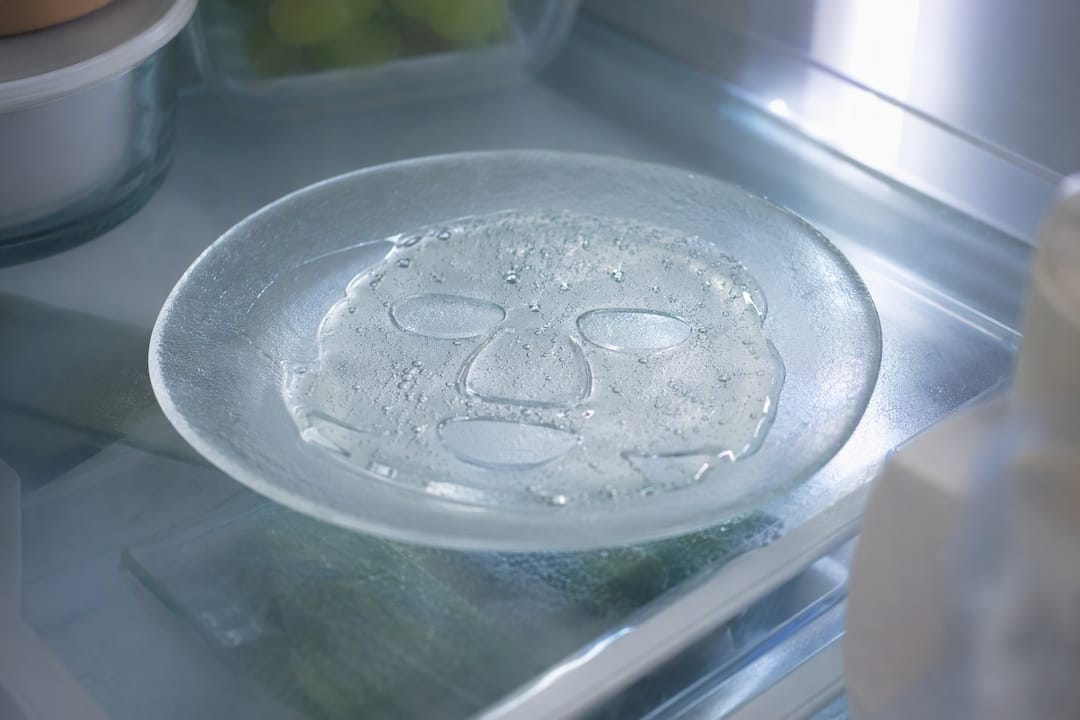
- Consider chilling the mask in the fridge beforehand for a cooling boost.
- Pick a spot where you can lie down, since gravity keeps the gel from sliding.
Pro Tip: Keep your hydrogel masks in the refrigerator so one is always ready to go. Cold gel against warm skin makes the de-puffing effect noticeably stronger.
What is the correct way to apply a hydrogel mask?
Most hydrogel masks come in one of two constructions: a single sheet with a protective film on both sides, or two separate pieces (upper and lower face). Check your product’s instructions before you start, since removal technique varies slightly by brand.
- Open the packet and unfold the mask flat on a clean surface or your palm.
- Peel the liner off slowly, starting at one corner, to avoid tearing the gel.
- Tilt your head back slightly and lay the mask flush against your skin, starting with the lower half so your jawline and cheeks anchor the fit.
- Bring the upper half up over your nose and forehead, centering the eye and nose cutouts before pressing down.
- Smooth from the center of your face outward toward your ears and jaw, pressing gently around your eyes, nose, and mouth for full contact with no air pockets.
- Let it sit for the recommended time on your packaging.
Fit issues are common and easy to fix on the spot:
- If the eye holes sit too high or low, gently reposition before the gel adheres fully.
- For a narrower face, overlap the edges slightly rather than leaving gaps at the jaw.
- For a wider face, stretch the mask carefully at the cheeks instead of forcing it to meet at the center.
When time is up, peel from the outer edges inward, working slowly. Tugging from the center can stretch or tear the gel and pull at your skin unnecessarily. Whatever jelly remains on the mask or in the packet is not waste. Save it for your neck.
How long should you leave a hydrogel mask on?
Wear time depends on what the formula is built for. A quick refresh runs 20 to 40 minutes, while deep-treatment versions can stay on for one to three hours. Overnight wear is only appropriate when the packaging explicitly says so.
You’ll often notice the mask start to shrink slightly or feel tackier as it absorbs, which is a rough signal that it has done most of its work. Once it fully dries out and curls at the edges, it’s past useful and starting to pull moisture back out of your skin instead of delivering it.
Frequency depends on your skin type:
- Normal to dry skin: 2 to 3 times weekly with gentle, hydrating formulas.
- Oily or combination skin: 1 to 2 times weekly is usually plenty.
- Active or exfoliating formulas (AHAs, retinol-adjacent ingredients): never daily. Give your skin recovery days in between.
Overusing an active-ingredient hydrogel mask is one of the fastest ways to trigger sensitivity, so scale back the moment you notice tightness or redness that lingers past application.
What should you do after removing the mask?
Don’t rinse right away. Pat whatever essence remains on your skin into your face, neck, and décolleté for five to ten minutes so it has a chance to absorb instead of evaporating.
Seal it with a moisturizer or facial oil, particularly if you’re in a dry climate or a heated or air-conditioned room. This locks the hydration in rather than letting it sit on the surface and disappear overnight.
A few follow-up habits make the routine worth repeating:
- If your mask contained brightening or active ingredients, apply sunscreen the next morning without exception.
- Don’t toss unused serum still in the packet. Smooth it over your hands and neck, areas that show aging just as fast as your face but rarely get the same attention.
- Give your skin a full look in the mirror the next day rather than right after removal. Hydrogel results often look better once the product has had a few hours to settle.
Pro Tip: Keep a small dish by your sink for leftover packet serum so you actually use it on your neck and hands instead of forgetting about it mid-routine.
What tips improve hydrogel mask results?
Small habits make a bigger difference than most people expect. Chilling the mask in the fridge for 10 to 25 minutes before use amplifies the cooling effect, which helps constrict blood vessels and reduce visible puffiness faster than a room-temperature mask.
Lying down while it’s on matters more than it seems. Standing or moving around gives gravity a chance to pull the mask down your face, which means uneven contact and wasted serum on your towel instead of your skin.
Watch for these common mistakes:
- Applying the mask to skin that’s still wearing makeup, SPF, or oil buildup, which blocks contact and absorption.
- Leaving the mask on until it fully dries out, unless the label says it’s built for extended or overnight wear.
- Using a fresh hydrogel mask right after a strong in-office procedure or on skin with active breakouts or abrasions, without checking with a professional first.
- Discarding leftover jelly instead of repurposing it for your neck or hands.
None of these fixes cost extra money. They just require a little more attention to the process itself.
Can you sleep in a hydrogel mask?
Only if the product says so. Always check the label for an explicit overnight claim before you go to bed in one, since not every hydrogel formula is designed to stay hydrated and effective for that long.
If your skin is sensitive, prioritize fragrance-free, hypoallergenic formulas and skip anything with exfoliating acids. Peptide and humectant-forward gels tend to be the gentlest overnight option, and a patch test is still worth doing even with a “sensitive skin” label on the box.
If you’ve recently had a professional treatment like microneedling or a chemical peel, check with your provider before layering a mask on top, active or otherwise.
Remove the mask immediately if you notice:
- Stinging or burning that doesn’t fade within a minute or two.
- Redness that spreads or intensifies rather than staying mild.
- Any swelling around the eyes, mouth, or cheeks.
Why do hydrogel masks work the way they do?
A hydrogel sheet acts almost like a second skin. It forms a semi-occlusive film that slows water loss from your skin’s surface, which gives humectants like hyaluronic acid and glycerin more time to actually absorb instead of evaporating away, according to dermatology-backed coverage in British Vogue.
The cooling sensation isn’t just pleasant. It triggers mild vasoconstriction, which is why puffiness and redness visibly calm down within minutes of application.
A quick reality check: hydrogel masks are supportive, not transformative. The same reporting notes they work best as an adjunct to daily fundamentals like cleansing, barrier repair, and sunscreen, not a replacement for them.
Compared to fiber sheet masks, hydrogel formulas hold their shape and stay put with a cleaner, less messy delivery of active ingredients:
- Gel structure clings evenly without sliding off mid-application.
- Semi-occlusive layer slows evaporation so actives penetrate rather than sitting on the surface.
- Cooling effect calms visible redness and puffiness almost immediately.
How does the Biodance mask fit this routine?
Vervexofficial built its hydrogel line around one specific verification tip in this article: the mask turns transparent as it absorbs, so you can actually see the nutrient penetration happening instead of guessing whether it worked. That’s a direct answer to the shrinking or thinning texture cue described in the timing section above.
The Biodance Bio-Collagen Real Deep Mask is hypoallergenic and formulated for hydration, elasticity, and pore refinement, and it’s built to be used overnight when your skin needs a deeper reset. For a lighter, more frequent routine, the standard Biodance mask works well two to three nights a week.
- Over 100,000 reviews back the brand’s hydration claims.
- 98% of users report noticeably improved hydration after use.
- Formulas are free of common irritants, which matters for sensitive skin.
Why we built an overnight, see-through mask
We designed our hydrogel line around one problem: most people can’t tell if a mask is actually working until the next morning, if at all. An overnight mask that turns transparent solves that by letting you watch the serum disappear into your skin in real time, whether you’re using it for a quick midweek reset or recovering from a long flight.
If you’re new to hydrogel masks, patch-test the first one, start with once or twice a week, and adjust frequency based on how your skin responds.
— Vervex
Ready to try an overnight hydrogel mask?
Most sheet masks ask you to babysit them for 20 minutes on the couch. Vervexofficial’s hydrogel masks are built for the opposite: apply before bed, wake up to visibly absorbed, transparent gel, and skip the mid-mask fussing altogether.

The Biodance Bio-Collagen Real Deep Mask follows the exact routine covered above: cleanse, align, smooth, then let it work overnight while you sleep. It’s hypoallergenic, free of common irritants, and formulated to deliver hydration and firmness without a multi-step routine attached to it. If you travel often, have limited time for skincare, or just want proof your mask is actually doing something, this is the one to start with. Order a pack, apply it tonight, and check your skin’s absorption for yourself by morning.
Sources
- 5 Tips for Using a Hydrogel Mask — 100% PURE
- 9 Best Hydrogel Masks For Glass Skin, According To Experts | British Vogue