
Pick hydrogel if you want instant cooling, visible “wow” hydration, and a lower unit cost. Pick bio cellulose if you want the thinnest second skin adhesion and premium, longer wear delivery. Neither material beats the other across every job. For overnight hydration and elasticity support at home, a hydrogel mask is the practical, cost-effective pick.
TL;DR:
- Hydrogel masks provide immediate cooling and visible hydration, making them ideal for quick results and overnight use at home.
- Bio cellulose masks offer a highly conforming fit with longer-lasting occlusive hydration, suitable for post-procedure recovery and extended wear.
- Hydrogel masks are cheaper to produce with lower minimum order quantities, but bio cellulose requires longer fermentation processes and has a higher per-unit cost.
- The choice depends on budget, mask wear duration, and desired sensory effects, with hydrogel favored for affordability and instant feedback.
- Transparency during absorption offers visual proof of active penetration, appealing to users seeking measurable results and building trust.
Table of Contents
- Hydrogel vs Bio Cellulose: What Are They Actually Made Of?
- How Do Hydrogel and Bio Cellulose Deliver Hydration?
- Which One Fits Better and Feels Better on Skin?
- What Do Hydrogel and Bio Cellulose Cost to Source?
- Hydrogel or Bio Cellulose: How Do You Decide?
- Why Vervexofficial Builds Hydrogel, Not Bio Cellulose
- Our Take on the Hydrogel vs Bio Cellulose Debate
- Get the Hydrogel Results Without the Guesswork
- Sources
- FAQ
Hydrogel vs Bio Cellulose: What Are They Actually Made Of?
Hydrogel masks are cast from crosslinked polymer networks, usually built on carrageenan, agar, or other gel-forming polysaccharides, then loaded with water and active ingredients until the sheet becomes a soft, wobbly gel. These networks absorb enormous volumes of water relative to their weight, and that structure is exactly what makes them tunable for biomedical and cosmetic delivery. Manufacturers pour the gel into molds, cure it, then trim and package it, a process that scales fast and cheap.
Bio cellulose masks start from a completely different biological process. A bacterial strain, typically Komagataeibacter, ferments a sugar-rich liquid medium and secretes cellulose fibers that self-assemble into a dense nanofiber mat. That mat is harvested, washed, and cut into sheets. It is not poured or molded. It is grown.
The practical differences that follow from this:
- Bio cellulose sheets contain a very high water content by weight, locked inside a nanofiber matrix rather than a synthetic gel.
- Fermentation takes days to weeks, while hydrogel casting can turn around in hours.
- Bio cellulose biodegrades cleanly since it is pure cellulose; hydrogel biodegradability depends entirely on which polymer blend was used.
- Bio cellulose’s nanofiber network gives it mechanical strength hydrogel cannot replicate at the same thickness.
How Do Hydrogel and Bio Cellulose Deliver Hydration?
The two materials hydrate skin through genuinely different mechanisms, not just different textures.
Hydrogel works as a reservoir. Water and actives sit suspended inside the polymer matrix, and they release slowly onto the skin surface through osmotic diffusion as the mask cools and settles. That slow release is what produces the sharp, immediate cooling sensation people associate with hydrogel, and it is a real physical effect, not marketing. The tunable chemistry of hydrogel networks means formulators can adjust how fast that reservoir empties.
Bio cellulose works more like an occlusive second skin. Its nanofiber matrix presses flush against every contour of the face, trapping moisture underneath and physically blocking evaporation.
Bio cellulose’s dense fiber structure measurably reduces transepidermal water loss (TEWL) during wear, which is why estheticians describe it as creating an occlusive environment that enhances hydration for as long as the mask stays on.
What this means in practice:
- Hydrogel gives you a fast, obvious hydration hit within minutes, plus visible cooling.
- Bio cellulose delivers a steadier, occlusion-driven hydration curve that favors longer wear times.
- Repeated use tends to favor bio cellulose for barrier support, and hydrogel for perceived instant plumping.
Which One Fits Better and Feels Better on Skin?
Fit is where bio cellulose usually wins on paper. Its nanofiber mat is thin, flexible, and drapes into the folds around the nose, chin, and eyes far more precisely than a single cast hydrogel sheet can manage. That conformity holds up even when you move, talk, or lie down, which is part of why estheticians reach for bio cellulose for post-procedure comfort with minimal friction.
Hydrogel compensates with sensation. The cooling effect reads as immediate efficacy, and many brands now split hydrogel masks into two pieces, upper and lower face, specifically to improve fit around the jawline and cheeks.
Quick comparison points:
- Bio cellulose: near-invisible fit, minimal slipping, better for filming or daytime wear under makeup prep.
- Hydrogel: stronger cooling and depuffing feel, slightly more prone to sliding on oilier or more mobile skin.
- Overnight wear favors hydrogel formulations designed to stay put through sleep without warming and losing grip.
Pro Tip: If a hydrogel mask starts sliding, it has usually warmed to skin temperature and released most of its reservoir. That is your cue it has done its job, not a sign of poor adhesion.
What Do Hydrogel and Bio Cellulose Cost to Source?
For product developers and sourcing managers, the substrate choice is as much a manufacturing decision as a skincare one. OEM data puts hydrogel per-unit cost lower than bio cellulose, with typical minimum order quantities around 3,000 to 10,000 units. Bio cellulose runs higher per unit and typically carries MOQs in the 5,000 to 20,000 range, a direct consequence of fermentation timelines that stretch production far longer than casting a gel.
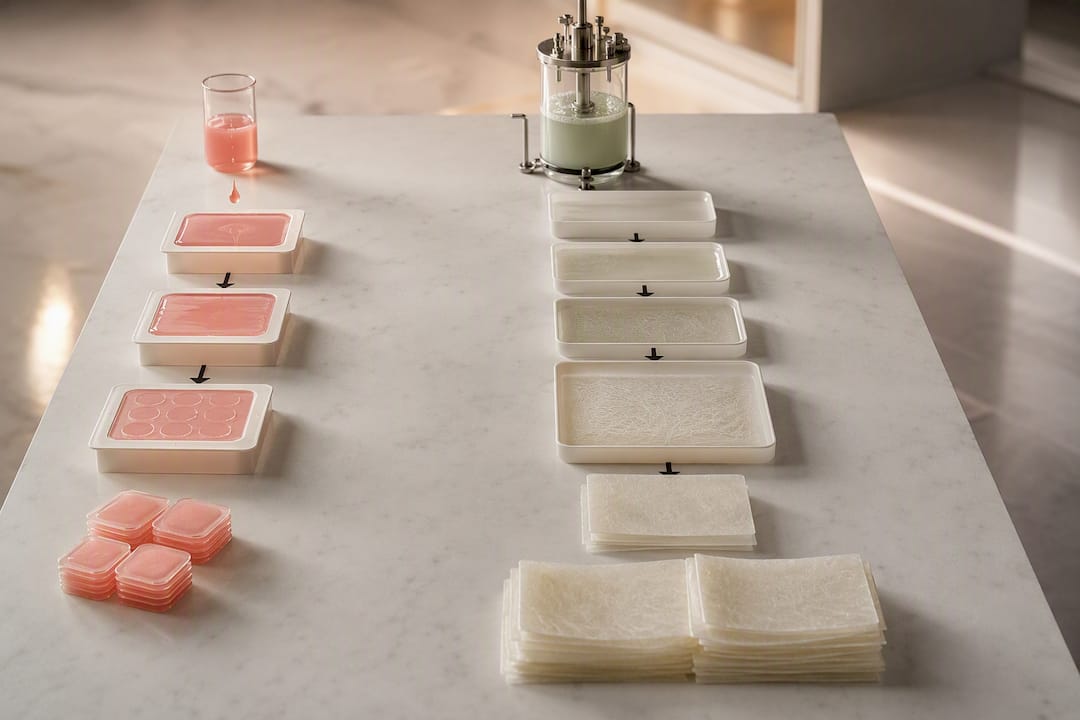
Packaging economics diverge too. Hydrogel’s high water content adds shipping weight and demands tighter preservative and packaging controls to prevent microbial growth in transit. Bio cellulose’s fermentation cost is the tradeoff for a material that ships slightly lighter per sheet but costs more to grow.
Before briefing any manufacturer, run through this checklist:
- Confirm factory capability for your chosen substrate, not just general mask production.
- Request a pilot run before committing to full MOQ, especially for bio cellulose given longer fermentation cycles.
- Ask for documented lead times covering fermentation or casting plus curing and packaging.
- Request certification paperwork for hypoallergenic or dermatologist-tested claims upfront.
- Clarify preservative systems, particularly for hydrogel’s higher water content.
Hydrogel or Bio Cellulose: How Do You Decide?
The decision comes down to three questions: What is your price ceiling, how long does the mask need to stay on, and what sensory experience are you selling?
If price sensitivity matters and the mask is a mass or mid-premium product, hydrogel wins on economics and shelf appeal. If you are positioning a premium, clinical, or flagship SKU, bio cellulose’s higher per-unit cost becomes commercially sensible because customers expect to pay more for it, an industry pattern confirmed by B2B sourcing data comparing both substrates.
Consumer quick-buy checklist:
- Want visible cooling and fast results tonight? Choose hydrogel.
- Recovering from a facial or in-office treatment? Choose bio cellulose for minimal friction.
- Traveling or short on time? Hydrogel’s simple one-step application wins.
| Factor | Hydrogel | Bio Cellulose |
|---|---|---|
| Hydration delivery | Fast reservoir release, strong cooling | Occlusive, reduces TEWL steadily |
| Adhesion and fit | Good, improved by two-piece designs | Excellent, conforms to contours |
| Sensory feel | Cooling, dramatic | Soothing, near-invisible |
| Production complexity | Cast and cured, faster turnaround | Fermented, longer lead time |
| Typical unit cost | Lower | Higher |
| Biodegradability | Depends on polymer blend | Naturally biodegradable |
Why Vervexofficial Builds Hydrogel, Not Bio Cellulose
Some brands make hydrogel overnight masks because hydrogel fits how people actually use masks, which is late at night, without a routine built around them. These masks can be formulated to turn transparent as they absorb, so you can watch the nutrient penetration happen instead of guessing whether the product worked.
That visible cue targets three specific concerns:
- Hydration that lasts through a full night of sleep.
- Elasticity support for skin that looks tired by evening.
- Pore size reduction without an extra serum step.
The transparent-on-absorption behavior is not a gimmick. It gives you a direct, visual signal that the formula has moved from the mask into your skin, which is the kind of proof busy users and skincare beginners actually want before they trust a new product.
The Biodance Bio-Collagen Real Deep Mask pack and the broader Biodance mask lineup are hypoallergenic and built for sensitive skin, which matters if you have reacted to fragrance or preservative-heavy sheet masks before.
Our Take on the Hydrogel vs Bio Cellulose Debate
The research here supports a conclusion most articles avoid stating plainly: this is not a quality contest, it is a job-fit contest. Bio cellulose earns its premium price through fermentation time and adhesion performance that hydrogel structurally cannot match at the same thickness. Hydrogel earns its spot through cooling sensation, cost, and speed to production that make it the more sensible choice for daily and overnight use.
Where conventional advice falls short is treating “better” as a fixed property of the material rather than a function of the use case. A post-procedure clinic setting and a Tuesday-night home routine are not the same job, and they should not default to the same substrate.
For most people building a nightly routine, prioritize hydrogel’s cost efficiency and immediate hydration signal over marginal adhesion gains that matter more in clinical settings than in a bathroom mirror at 10 p.m.
— Vervex
Get the Hydrogel Results Without the Guesswork
Some hydrogel mask products offer visible confirmation as they absorb, providing a visual signal that hydration and actives are penetrating the skin. Such products may appeal to busy professionals, frequent travelers, and skincare beginners who want proof, not a ten-step routine.
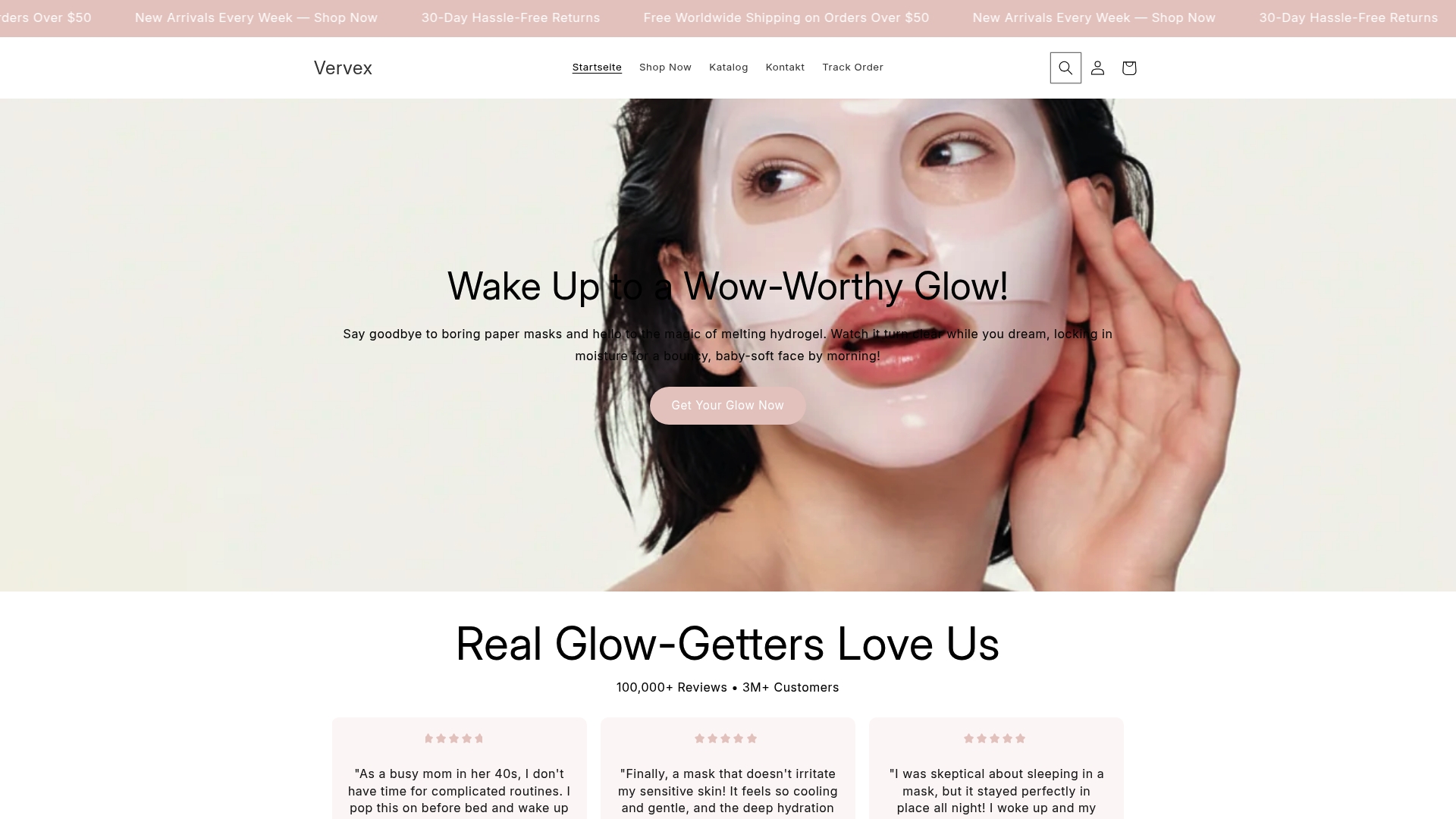
The formulas are hypoallergenic and built for sensitive skin, targeting hydration, elasticity, and pore size in one overnight step. If tonight’s routine needs an upgrade, start with the Biodance Bio-Collagen Real Deep Mask pack of 4 and see the transparency effect for yourself.
Sources
For the material science behind this comparison, read the review on hydrogel structure and biomedical applications and the companion review on bacterial cellulose properties. For sourcing numbers, see the B2B sourcing guide and the professional hydration guide. Product details live on the Biodance mask page.
- Hydrogels: Properties and Applications in Biomedicine
- Hydrogel vs Bio-Cellulose Facial Masks: B2B Sourcing Guide
- Hydrogel vs. Biocellulose Mask Sheets: Which is Better for Hydration? The Professional’s Guide
FAQ
Do Bio Cellulose Masks Actually Work?
Yes. Bio cellulose’s dense nanofiber matrix creates an occlusive barrier that reduces transepidermal water loss and holds hydration against the skin for the full wear time.
Do Hydrogel Face Masks Really Work?
Yes, hydrogel masks work through a reservoir mechanism that releases water and actives steadily, producing both a cooling sensation and measurable surface hydration during and after wear.
What Is the Difference Between Hydrogel and Bio Cellulose Masks?
Hydrogel is a cast polymer gel with high water content and strong cooling, while bio cellulose is a fermented nanofiber mat known for tighter adhesion and longer, steadier hydration delivery.
Is a Hydrogel Mask Better Than a Gelatin-Based Mask?
Hydrogel masks generally offer more consistent hydration release and gentler removal than gelatin-based peel-off masks, which rely on drying and physical peeling rather than gradual absorption.
Which Mask Type Should Beginners Start With?
Hydrogel is the easier entry point for beginners because it requires no special technique, delivers visible results quickly, and typically costs less per unit than bio cellulose.