
A minimalist skincare routine means four products, max: a gentle cleanser, an optional antioxidant serum in the morning, a moisturizer, and daily sunscreen. Dermatologists confirm this covers most of what topical skincare can achieve, while cutting irritation risk that comes from stacking actives. It fits sensitive skin especially well, since fewer products mean fewer chances for a reaction.
TL;DR:
- A minimalist skincare routine includes a gentle cleanser, an optional antioxidant serum, a moisturizer, and daily sunscreen, focusing on efficacy and irritation reduction.
- Sensitive skin requires stricter ingredient screening, patch testing, and avoidance of fragrances, alcohol, and rough scrubs to protect the compromised skin barrier.
- Adding targeted treatments like retinoids or acids should be gradual, with one active introduced at a time and a wait of four to six weeks to assess effectiveness.
- Ongoing mistakes like applying too little sunscreen or over-exfoliating can undermine the routine’s simplicity and skin health.
- A weekly hydrogel mask can complement the routine by providing extra hydration without adding daily complexity.
Table of Contents
- What goes into a minimalist skincare routine?
- Should your morning and evening routines be different?
- How do you build a minimalist routine for sensitive skin?
- When should you add a targeted treatment?
- What does a minimalist routine look like by skin type?
- What mistakes turn a simple routine into a complicated one?
- Where does a weekly hydrogel mask fit into a minimalist plan?
- Why we recommend simplicity over complexity
- A simple weekly boost that fits a minimalist routine
- Where this article’s guidance comes from
- Sources
What goes into a minimalist skincare routine?
Four product categories carry the entire routine. Everything else is optional.
Cleanser. Its job is to remove dirt, oil, and sunscreen without stripping the skin barrier. Look for a pH-balanced, sulfate-free, fragrance-free formula. If your skin feels tight or squeaky after washing, the cleanser is too harsh. Gel cleansers tend to suit oily skin, while cream or lotion cleansers work better on dry or sensitive skin.
Antioxidant serum (optional). Vitamin C is the most researched option here. It helps defend skin against environmental stress during the day and can brighten uneven tone over time. It’s the one step you can skip entirely without losing much, which is why it stays optional in a minimalist skincare routine rather than mandatory.
Moisturizer. This is the workhorse product, and it does three jobs at once: a humectant pulls water into the skin, an emollient smooths the surface, and an occlusive seals moisture in. A single well-formulated moisturizer, ideally with ceramides, glycerin, or hyaluronic acid, can perform all three functions. Ceramides matter more than most people realize. They make up a large share of the lipids that hold the skin barrier together, so a moisturizer built around them does more for long-term skin health than one built around a trendy botanical extract.
Sunscreen. Broad-spectrum sunscreen, applied every morning regardless of weather. Most people apply too little. The standard guidance is to apply a generous amount for the face alone, and to reapply regularly with extended sun exposure. Dermatologists interviewed by NPR name sunscreen, cleanser, and moisturizer as the three non-negotiables, and sunscreen is the one step that pays off for decades, not days.
Layering order follows one rule: thinnest to thickest.
- Cleanser first, always.
- Vitamin C serum next, if you use it. Give it about 60 seconds to absorb before applying anything else.
- Moisturizer follows to lock in hydration.
- Sunscreen goes last in the morning, as the final layer before makeup.
Should your morning and evening routines be different?
Yes, and the split is simple: mornings protect, evenings repair. Cleveland Clinic dermatologists frame it exactly this way, and it’s the single easiest way to keep a minimalist skincare routine from sprawling into ten steps.
- Morning: If your skin isn’t oily or sweaty, a splash of water may be enough instead of a full cleanse. Apply your optional vitamin C serum, then moisturizer, then sunscreen. That’s it. Three to four minutes, done.
- Evening: Cleanse to remove sunscreen, oil, and the day’s grime. This step matters more than most people think, since leftover sunscreen and pollutants sitting on skin overnight can clog pores. Follow with moisturizer, and layer in any targeted treatment (retinoid, exfoliant) here instead of in the morning.
- Skip the extras: No evening antioxidant serum needed. No toner unless you have a specific reason. No seven-step layering ritual.
Both routines should take under five minutes once you know the order. The goal isn’t fewer products for its own sake. It’s spending your effort on the two or three steps that actually move the needle.
How do you build a minimalist routine for sensitive skin?
Sensitive skin doesn’t need fewer steps than the standard routine. It needs stricter ingredient screening at every step. The skin barrier in reactive skin is already compromised, so ingredient choice matters more than quantity of products.
Prefer: ceramides, glycerin, niacinamide, colloidal oatmeal, and petrolatum-based occlusives. These calm and repair rather than challenge the barrier.
Avoid or limit: added fragrance (natural or synthetic), high concentrations of alcohol denat, essential oils, and physical scrubs with rough granules that create micro-tears.
Reading a label takes ten seconds once you know what to look for. Ingredient lists run from highest to lowest concentration, so check the first five to seven entries. If “fragrance” or “parfum” shows up early on that list, the product likely contains enough of it to trigger a reaction in reactive skin.
Patch testing is not optional for sensitive skin, and it’s not optional for a minimalist skincare routine either, because every new product is a potential variable you’re introducing into a system you’ve deliberately simplified. Apply a small amount to the inner forearm or behind the ear, once daily, for three to five days, before using it on your face. Watch for redness, itching, or bumps.

Pro Tip: If a product stings on first application, that’s not “purging” or “the product working.” Stinging on intact skin usually signals irritation. Rinse it off and don’t repeat the test.
If redness, swelling, or persistent itching shows up during a patch test or after adding a product to your face, stop immediately. Persistent reactions that don’t resolve within a few days warrant a conversation with a board-certified dermatologist rather than more trial and error at home.
When should you add a targeted treatment?
Add one active ingredient at a time, and only when you have a specific concern the core four products aren’t addressing. Adding three new actives in the same week makes it impossible to tell which one is helping and which one is causing the redness you’re now dealing with.
- Retinoids for fine lines, texture, or acne: start at two to three nights a week, PM only, and increase frequency only once skin tolerates it without flaking or stinging.
- Chemical exfoliants (AHA/BHA) for texture or congestion: two to three times weekly, never on the same night as a retinoid, since stacking two strong actives multiplies irritation risk without multiplying benefit.
- Vitamin C stays a morning step, paired with sunscreen, since its antioxidant effect complements UV defense rather than competing with it.
Give any new treatment four to six weeks before judging it. A treatment that’s helping shows gradual, steady improvement. One that’s harming shows redness, flaking, or breakouts that show up within days and don’t settle down. If you can’t tell which effect you’re seeing, drop back to the core four products for two weeks and reassess.
What does a minimalist routine look like by skin type?
The four core products stay constant. What changes is formulation weight and one or two small additions.
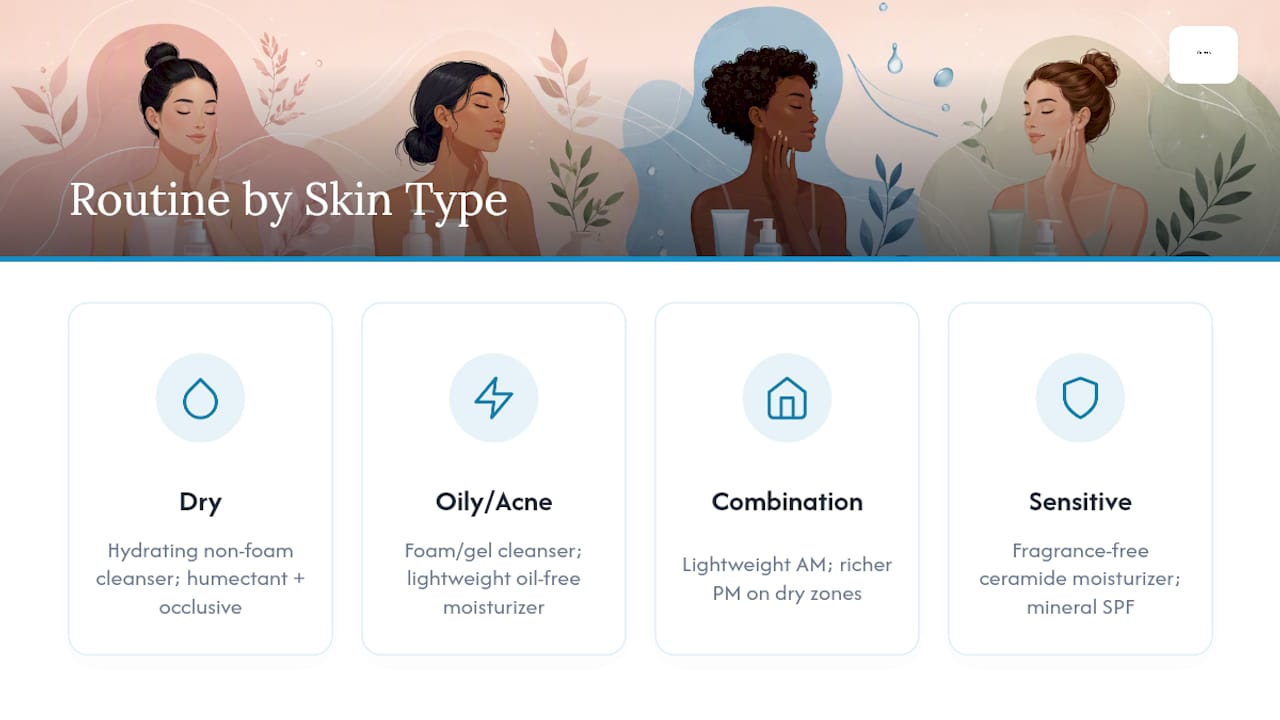
Dry skin: A hydrating, non-foaming cleanser. A moisturizer heavy on humectants (glycerin, hyaluronic acid) layered under an occlusive if your skin still feels tight. SPF 30+ mineral or hybrid sunscreen. In the evening, swap in a slightly richer, more emollient moisturizer to counter overnight water loss.
Oily or acne-prone skin: A gentle foaming or gel cleanser that doesn’t over-strip. A lightweight, non-comedogenic, oil-free moisturizer. Gel-based sunscreen to avoid a heavy finish. In the evening, this is where a targeted acne treatment like a low-strength benzoyl peroxide or salicylic acid product earns its spot, used two to three nights weekly.
Combination skin: Keep morning products lightweight across the whole face. In the evening, apply a richer moisturizer specifically on drier zones (often cheeks) and skip it or use less on the T-zone.
Sensitive skin: Fragrance-free, ceramide-focused moisturizer as the anchor product. Mineral sunscreen (zinc oxide or titanium dioxide) tends to sit better than chemical filters for reactive skin. Keep active ingredients to a minimum, and patch test everything new, including “sensitive skin” labeled products, since that label isn’t regulated.
Healthline’s pared-down approach backs this up with a three-product core for readers who want to strip things down even further than four steps, treating vitamin C strictly as a bonus rather than a requirement.
What mistakes turn a simple routine into a complicated one?
A few habits quietly undo the whole point of going minimal.
Applying too little sunscreen, or mixing it into your moisturizer to “save a step,” dilutes the SPF below its labeled protection. Apply sunscreen as its own final layer, at full strength. Adding two or three new actives in the same week makes every reaction untraceable. Exfoliating daily “for faster results” instead of two to three times weekly strips the barrier faster than it can repair. Using a foaming cleanser that leaves skin feeling tight, then reaching for a heavier moisturizer to compensate, is treating a symptom instead of fixing the cause. And continuing a product through visible irritation, hoping it will “get better,” almost always makes things worse before it makes them better, if it ever does.
Where does a weekly hydrogel mask fit into a minimalist plan?
A weekly overnight step can support a minimalist skincare routine without adding daily complexity, as long as it’s positioned correctly: an occasional adjunct, not a new daily habit. Applied one to two times a week after cleansing and before your regular moisturizer, an overnight hydrogel mask adds a concentrated hydration boost while you sleep.
Vervexofficial’s hydrogel masks are built for exactly this slot. Formulated to be hypoallergenic and suited to sensitive skin, they use an absorption technology that turns transparent as the mask is absorbed, so you can see the nutrient penetration happening rather than guessing whether the product did anything.
- Use it once or twice weekly, never as a daily replacement for moisturizer.
- Apply after cleansing, before your usual nighttime moisturizer.
- The daily core stays exactly what it was: cleanser, moisturizer, and sunscreen.
One weekly step, added deliberately, doesn’t compromise minimalism. Ten daily steps do.
Why we recommend simplicity over complexity
Complexity feels productive. It rarely is. Most of the irritated, uneven, reactive skin we hear about traces back to routines with nine or ten products layered on top of each other, not to a lack of options. An editor on our team ran an eight-week stretch with nothing but a cleanser, ceramide moisturizer, and sunscreen, adding only a retinoid on alternating nights in week four. Redness that had lingered for months cleared within three weeks, once the skin stopped fighting off a rotating cast of new products.
Consistency beats complexity because a barrier needs time, not variety, to repair. Track your skin for four to six weeks before changing anything, and never introduce more than one new active at a time.
— Vervex
A simple weekly boost that fits a minimalist routine
Most of what your skin needs, it gets from three daily steps. But once a week, skin can use more than daily maintenance offers, and that’s a gap a single overnight treatment can close without adding a single extra daily step.

The Biodance Bio-Collagen Real Deep Mask is built for exactly that gap. It’s a hydrogel formula designed to be applied once or twice a week, after cleansing, in place of nothing you’re already doing. The hypoallergenic formulation was developed with sensitive skin in mind, and the mask turns visibly transparent as it absorbs overnight, so you can see the hydration happening rather than take it on faith. It doesn’t replace your moisturizer or sunscreen. It sits alongside them, on the one or two nights a week you choose to use it.
If your routine is already down to the essentials and you’re looking for the one addition worth making, check out the pack of four and see how it fits into your week.
Where this article’s guidance comes from
The routine outlined here draws on patient education from the National Institute of Arthritis and Musculoskeletal and Skin Diseases on skin structure, a clinical overview of skin barrier function covering topical therapy evidence, practical guidance from Cleveland Clinic dermatologists on simple daily routines, and dermatologist-sourced recommendations reported by NPR on the three essential product categories.
This article is general information, not a substitute for advice from a qualified doctor. Consult a qualified healthcare professional about your own circumstances before acting on anything here.
Sources
- NIAMS: Learning about skin
- NCBI Bookshelf: Clinical overview of skin barrier and topical therapy
- NPR: 3 essential skin care products to keep your skin healthy and attractive
- Cleveland Clinic: What products do I actually need for a simple everyday skin care routine?
- Glowstice: The minimal effective routine: 4 products, maximum results