
Do this four-step routine every morning and night and you’ll capture the vast majority of topical skincare benefit in under five minutes a day. Cleanse, treat with one serum, moisturize, and apply broad-spectrum SPF in the morning; skip the SPF at night. Mornings cost about four minutes. Evenings run two to four. Add an overnight hydrogel mask like Vervex a few nights a week for extra hydration without adding a single active step to your day.
TL;DR:
- A four-product skincare routine delivers around 80% of benefits for most skin types, emphasizing a cleanser, one active serum, a moisturizer, and SPF.
- A realistic morning and evening routine takes about five minutes each, with the night routine focusing on removing SPF and makeup before applying treatment and moisturizer.
- Using an overnight hydrogel mask two to three nights a week enhances hydration without adding active steps and can be easily integrated into the standard routine.
- Popular active ingredients for quick routines include vitamin C, niacinamide, ceramides, and hyaluronic acid, with a focus on simple, targeted formulations.
- Consistency and simplicity are more effective than complexity, with habit stacking and preparation helping to maintain adherence over time.
Table of Contents
- What Does Skincare for Busy Professionals Actually Require?
- How Fast Can a Real Skincare Routine Actually Be?
- Simplify Your Evening Recovery Routine
- Smart Shortcuts That Don’t Cut Corners
- How to Pick Skincare Products Fast
- Making a Four-Minute Routine Actually Stick
- Why an Overnight Hydrogel Mask Fits a Packed Schedule
- Sources
- FAQ
What Does Skincare for Busy Professionals Actually Require?
Four products do almost all the work. A minimal routine of cleanser, antioxidant, moisturizer, and SPF covers the core needs dermatologists consider essential for most skin types, and each product has one job to do well.
Cleanser should be pH-balanced and sulfate-free. Foaming gels work for oily or combination skin; cream or lotion cleansers suit dry or sensitive skin better. Match it to your skin type once and stop shopping around.
Treatment is where a lot of routines get bloated with five serums doing overlapping jobs. Pick one high-yield active. Stable vitamin C in the morning fights free radical damage from sun and pollution; niacinamide works morning or night and calms redness while supporting the skin barrier. Apply serum to slightly damp skin so it absorbs faster, then give it thirty seconds before moving on.
Moisturizer needs three ingredient types in one bottle: a humectant (hyaluronic acid) to pull in water, an emollient to smooth the surface, and an occlusive to seal it in. Ceramide-based formulas do this well and reinforce the skin barrier at the same time.
Sunscreen is non-negotiable. The American Academy of Dermatology calls daily SPF the single most impactful step for preventing photoaging, full stop. Use broad-spectrum SPF 30 or higher, apply about a nickel-sized amount for the face, and pick a formula you’ll actually wear. A sunscreen sitting in a drawer protects nobody.
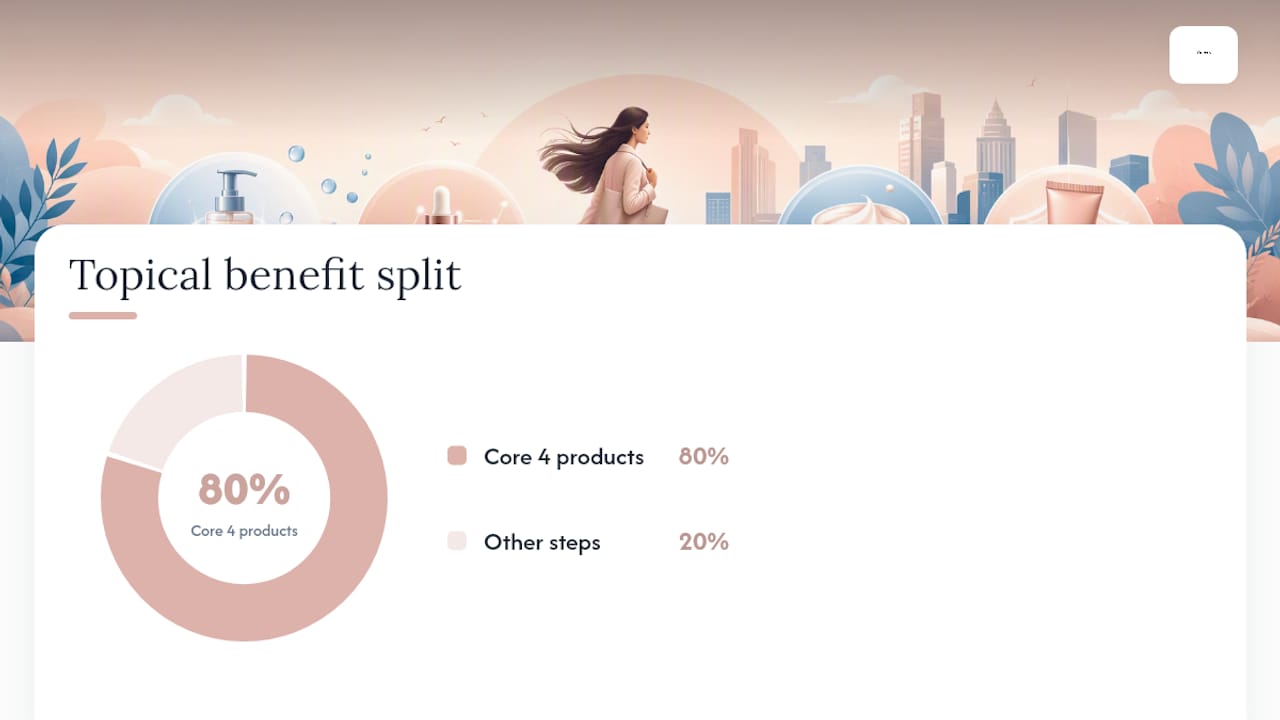
Statistic Callout: A four-product routine captures roughly 80% of the topical skincare benefit most people are chasing, according to minimal-routine research on adherence and results.
- Cleanser: pH-balanced, matched to skin type
- Treatment: one active, applied to damp skin
- Moisturizer: humectant, emollient, occlusive in one formula
- SPF: 30+, broad-spectrum, nickel-sized amount
How Fast Can a Real Skincare Routine Actually Be?
A quick skincare routine only works if the timing is realistic, not aspirational. Here is what each version looks like when you actually time it.
- 5-minute morning: Splash or cleanse (60 seconds), antioxidant serum (30 seconds), moisturizer (30 seconds), SPF (30 seconds). The remaining time covers patting products in while you check your phone or start the coffee maker. A properly sequenced 5-minute routine is genuinely effective when the steps happen in the right order.
- 5-minute evening: Single cleanse to remove the day (makeup wipe first if needed), then moisturizer. If you’re using a retinoid, apply it after cleansing and before moisturizer.
- 10-minute version: Add a double-cleanse (oil cleanser followed by your regular one) if you wear heavy makeup or sunscreen, or work in a targeted treatment for breakouts or dullness.
- 30-minute self-care routine: Reserve this for one or two nights a week. Use it for a hydrogel mask, gentle exfoliation, or a few minutes of facial massage while the mask sets.
Pro Tip: Pair your serum’s absorption time with something you’re already doing, like brushing your teeth or setting out tomorrow’s clothes. That thirty seconds stops feeling like waiting and starts feeling like nothing at all.
Simplify Your Evening Recovery Routine
Nighttime is when skin does its repair work, and the order you apply products in determines how much of that work actually happens. Remove SPF and makeup first, apply your treatment step, then seal everything in with moisturizer. Skipping the removal step and layering products on top of sunscreen residue is one of the most common ways a night routine underperforms.
Retinoids are the highest-yield night active for most adults, but they need a careful entry point. Start with a lower concentration two to three nights a week, and consider a short-contact approach, applying the product, doing something else for a few minutes, then moisturizing over it. Sensitive skin types often do better starting with bakuchiol, a gentler plant-derived alternative, before graduating to a retinoid.
- Remove the day’s SPF and makeup before anything else
- Apply treatment, then moisturizer, in that order
- Micellar water or a cleansing balm handles most makeup removal in one pass
- An overnight hydrogel mask can replace your regular moisturizer step on the nights you use one, adding hydration without extra effort
Smart Shortcuts That Don’t Cut Corners
Combining steps saves time, but only when it doesn’t dilute the step that matters most. A tinted moisturizer with SPF works fine for low-sun-exposure days, but don’t rely on a foundation with “SPF 15” listed in tiny print as your actual sun protection. It’s rarely applied thick enough to deliver real coverage.
- Keep a desk stash: travel-size SPF, a hydrating facial mist, and lip balm with SPF for midday touch-ups
- Reapply sunscreen every two hours if you’re near a window or outdoors at lunch
- Pack skincare in TSA-compliant 3.4-ounce containers and keep them in your carry-on, not checked luggage
- Prep tomorrow’s products on your bathroom counter the night before
Pro Tip: Habit stacking beats willpower. Set your serum next to your toothbrush and you’ll never forget the step that actually needs remembering.
How to Pick Skincare Products Fast
Reading a label under fluorescent store lighting with four minutes before a meeting is not the time to overthink this. Use a short checklist instead.
- Actives to look for: vitamin C, niacinamide, ceramides, hyaluronic acid, and SPF 30+ are the ingredients doing the most consistent work across skin types
- Formulation cues: fragrance-free, non-comedogenic labeling, and a pH close to skin’s natural range for cleansers
- Red flags: vague “clinically proven” claims with no percentage or concentration listed anywhere on the packaging
- Patch test first: apply a small amount to your inner arm for two nights before using a new product on your face
- One at a time: introduce a single new product every one to two weeks so you can actually tell what’s working
Statistic Callout: Sticking to a short, consistent routine improves long-term adherence more than adding extra steps most people abandon within weeks.
If you’re dealing with a diagnosed skin condition like rosacea, check with a dermatologist before building a routine around general advice. General guidance works for general skin. It doesn’t replace a diagnosis.
Making a Four-Minute Routine Actually Stick
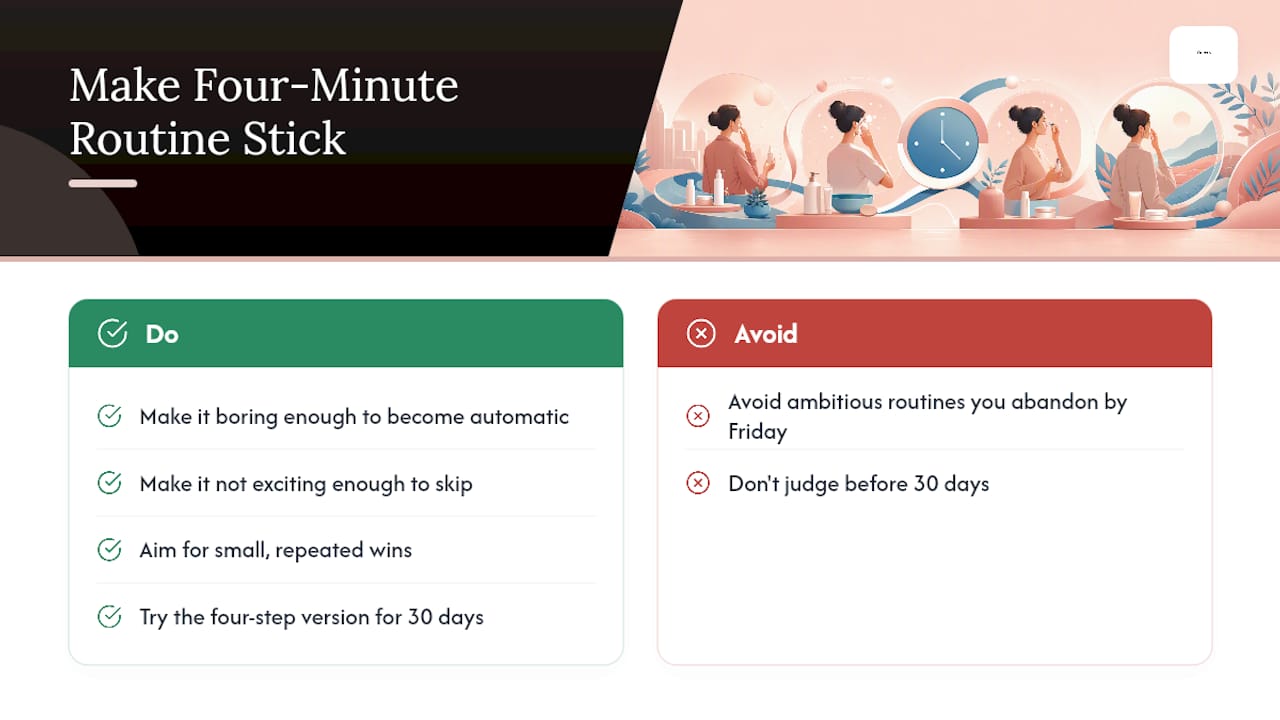
The routine that works isn’t the most advanced one. It’s the one you still do in week six. A four-minute morning routine sticks when it’s boring enough to become automatic, not exciting enough to skip on a bad day. Small, repeated wins beat ambitious routines you abandon by Friday.
Try the four-step version for 30 days before judging it. Consistency, not complexity, is what shows up in the mirror.
— Vervex
Why an Overnight Hydrogel Mask Fits a Packed Schedule
A four-step routine covers the basics. An overnight hydrogel mask adds a hydration boost without asking for a single extra minute of active effort, since it works while you sleep instead of while you’re awake counting seconds. Some hydrogel masks turn transparent as they absorb, allowing visible confirmation of nutrient penetration rather than guessing whether a product did anything.

Use it two to three nights a week in place of your regular night moisturizer, then return to your standard routine the other nights. It’s not a replacement for cleanser, treatment, or SPF. It’s a booster for the nights you want more than the basics without adding more steps. The biodance mask works well as a single try, and the pack of four covers close to a month of twice-weekly use if you want to build it into a routine instead of testing it once. Order either one and see how your skin looks after the first week of consistent use.
Sources
- Fast and effective skin-care routine, according to dermatologists | Allure
- The Minimal Effective Routine: 4 Products, Maximum Results | Glowstice
- A Skincare Routine That Takes 5 Minutes (Morning & Night) | Layered Skincare
FAQ
What Skincare Do Professionals Use?
Most dermatologists point to a minimal four-product lineup: a gentle cleanser, one antioxidant or active serum, a moisturizer with ceramides, and broad-spectrum SPF 30 or higher.
What Is the 4-2-4 Rule in Skincare?
Definitions of this rule vary and it isn’t a standard dermatology framework, so treat any specific version you see online with caution rather than as settled guidance.
What Skincare Products Are in High Demand Right Now?
Vitamin C serums, niacinamide treatments, ceramide moisturizers, and overnight hydrogel masks are seeing strong demand because they deliver visible results with minimal daily effort.
What Is the Number One Skincare Product in the World?
There’s no single universally agreed “best” product, but broad-spectrum SPF is the step dermatologists most consistently rank as the highest-impact daily habit for long-term skin health.
How Often Should I Use an Overnight Hydrogel Mask?
Two to three nights a week works well for most people, using it in place of a regular night moisturizer rather than stacking it on top of a full routine.