
Land, cleanse, hydrate, seal. That’s the order. Wash off SPF and cabin grime with a gentle cleanser, press a hyaluronic acid serum into slightly damp skin, then lock it in with a ceramide moisturizer. Add cool eye patches if you’re puffy, skip a hydrogel mask like Vervex’s for a deeper 20 to 40 minute soak, and leave retinoids and acids alone for the next 24 to 72 hours.
TL;DR:
- Hydrating with humectants and sealing with ceramides is crucial within minutes of skincare application to prevent water loss and barrier damage after a flight.
- Using hydrogel masks during a 20 to 40 minute window enhances hydration retention and calms puffiness better than shorter treatments or sheet masks.
- The first three days post-flight involve gentle cleansing, hydration, and barrier repair, with active ingredients like acids or retinoids avoided until skin stabilizes.
- Long flights exceeding six hours require mid-flight reapplication of humectants and richer moisturizers to counteract extended low humidity and pressure effects.
- Pre-flight hydration and avoiding alcohol or caffeine during the flight help preserve skin’s moisture reserves, speeding up recovery after landing.
Table of Contents
- Your Post-Flight Skincare Routine, Step by Step
- Why Do Flights Damage Your Skin?
- What Ingredients Actually Help After a Flight?
- The 72-Hour Recovery Window, Day by Day
- Should You Adjust Your Routine by Flight Length?
- Why Hydration Before and During the Flight Matters
- How to Protect Your Skin During a Dry Flight
- Managing Redness, Irritation, and Breakouts After Flying
- Does Skin Type Change Your Post-Flight Routine?
- A Note From the Brand on Recovering After a Flight
- Recover Faster With a Travel-Ready Hydrogel Mask
- Sources
Your Post-Flight Skincare Routine, Step by Step
Skin doesn’t need a dramatic intervention after a flight. It needs water, lipids, and about 20 minutes of your attention. Here’s the order that actually works, whether you’re heading straight to a meeting or collapsing into a hotel bed.
- Cleanse first, always. If you wore SPF or makeup, do an oil or balm cleanse to break down product, then follow with a gentle cream or gel cleanser. No SPF on? A micellar wipe followed by a light cleanser still clears the recycled cabin air residue sitting on your face.
- Mist or dampen skin before your serum. Humectants like hyaluronic acid work by pulling moisture into the skin, so they need water to grab onto. Applying them to bone dry skin can backfire.
- Layer a humectant serum, then a ceramide-rich moisturizer within a minute or two, before the humectant evaporates and takes hydration with it.
- Treat eyes and lips separately. Cool, refrigerated eye patches reduce puffiness fast, and an occlusive lip balm undoes the chapping that pressurized air causes almost immediately.
- Reach for a hydrogel or sheet mask if you have 20 to 40 minutes. Post-cleanse, before your regular moisturizer, is the right window. Hydrogel formats hold water against skin longer than a standard sheet mask, which matters when your skin barrier is depleted.
- Skip anything with retinol, strong acids, or fragrance for the rest of the day.
Pro Tip: Pack a small rollerball of ceramide cream and a single sachet mask in your carry-on. You want your recovery kit accessible the second you clear the jet bridge, not buried in checked luggage.
Why Do Flights Damage Your Skin?
Airplane cabins run at 10 to 20 percent humidity, well below the 40 to 60 percent range skin needs to hold onto water efficiently. That gap accelerates transepidermal water loss, which is the technical term for skin losing moisture faster than it can replace it. The result feels like tightness, flaking, or a strange combination of dry patches and an oily T-zone, because dehydrated skin often overproduces oil to compensate.
A few other cabin conditions compound the problem:
- Sitting still for hours slows lymphatic drainage, which shows up as under-eye and facial puffiness.
- Cabin pressure changes affect circulation, adding to that swollen, sluggish feeling.
- UVA exposure increases slightly at altitude, and research on flight crews has linked frequent flying to higher melanoma rates, which is a real argument for sunscreen even on a window seat.
- Sleep disruption and dehydration together can cause temporary inflammation, which reads on skin as redness or dullness.
What Ingredients Actually Help After a Flight?
Not every hydrating product performs the same job. Post-flight skin needs two categories working together, not one.
- Humectants like hyaluronic acid, glycerin, and panthenol pull water into the skin. Dermatologists consistently pair hyaluronic acid with an occlusive moisturizer, since a humectant applied alone in a dry cabin can actually pull moisture out of deeper layers if nothing seals it in.
- Barrier lipids like ceramides, squalane, and fatty acids fill in the gaps between skin cells, which is what actually slows water loss. This is the step people skip, and it’s the one that matters most on travel days.
- Soothing actives such as low-strength niacinamide, allantoin, and oat extract calm redness without adding irritation risk.
- Avoid retinoids, high-strength AHAs or BHAs, and enzymatic peels for at least 24 hours, ideally 72, since compromised skin barriers absorb actives more aggressively and irritate faster.
Hydrogel masks earn their spot here for a practical reason: they stay in contact with skin far longer than a splash-on serum, and their cooling effect helps with the puffiness that shows up after hours in a pressurized cabin. Formats like the Vervex biodance mask are built for exactly this kind of extended, low-effort contact time, which is hard to replicate with a five-minute routine.
The 72-Hour Recovery Window, Day by Day
Clinicians treat the first three days after a flight as a distinct recovery window, and skipping ahead is the most common mistake travelers make.
- Day 0 (landing day): Cleanse gently, hydrate, seal with ceramides, and use cool eye care. Avoid direct sun if you can, since skin is more reactive right now.
- Days 1 and 2: Stay in barrier repair mode. Humectant plus ceramide moisturizer, calming serums only, nothing exfoliating.
- Day 3: If skin looks calm, test one gentle active, like a low-dose vitamin C or a mild AHA, in isolation. If there’s still redness or tightness, extend the repair phase another day or two.
If irritation, breakouts, or congestion persist past day four, that’s a signal to see a dermatologist rather than layering on more products.
Should You Adjust Your Routine by Flight Length?
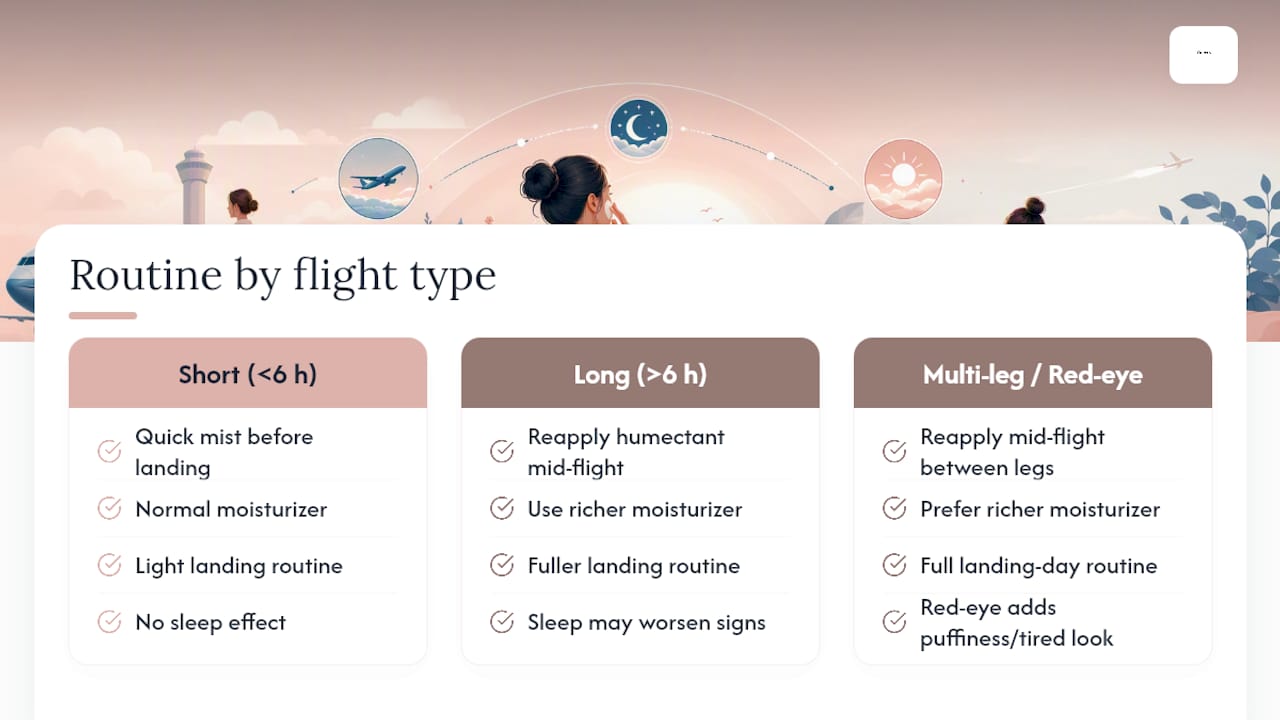
A 90-minute hop and a 14-hour long-haul don’t call for the same routine. Short domestic flights rarely drop cabin humidity long enough to cause serious water loss, so a quick mist and moisturizer touch-up before landing usually covers it.
Long-haul flights are a different story. Extended time in low humidity air compounds transepidermal water loss hour after hour, and multiple pressure changes during a multi-leg itinerary add cumulative strain on circulation and lymphatic flow. If you’re in the air more than six hours, reapply a humectant mist mid-flight and consider a richer moisturizer than you’d normally use, since skin has more time to dry out before you can properly treat it.
Red-eye flights add sleep deprivation into the mix, which shows up as puffiness and a grayish, tired look independent of hydration status. That combination calls for the fuller landing-day routine, including cool eye patches and a hydrogel mask if your schedule allows a 20 to 40 minute pause before you’re back on your feet.
Connecting through multiple cabins in one day, each with its own pressure and humidity swing, is the scenario where skin takes the biggest hit. Treat a multi-leg travel day the way you’d treat one long flight, not several short ones, when deciding how aggressively to hydrate on arrival.
Why Hydration Before and During the Flight Matters
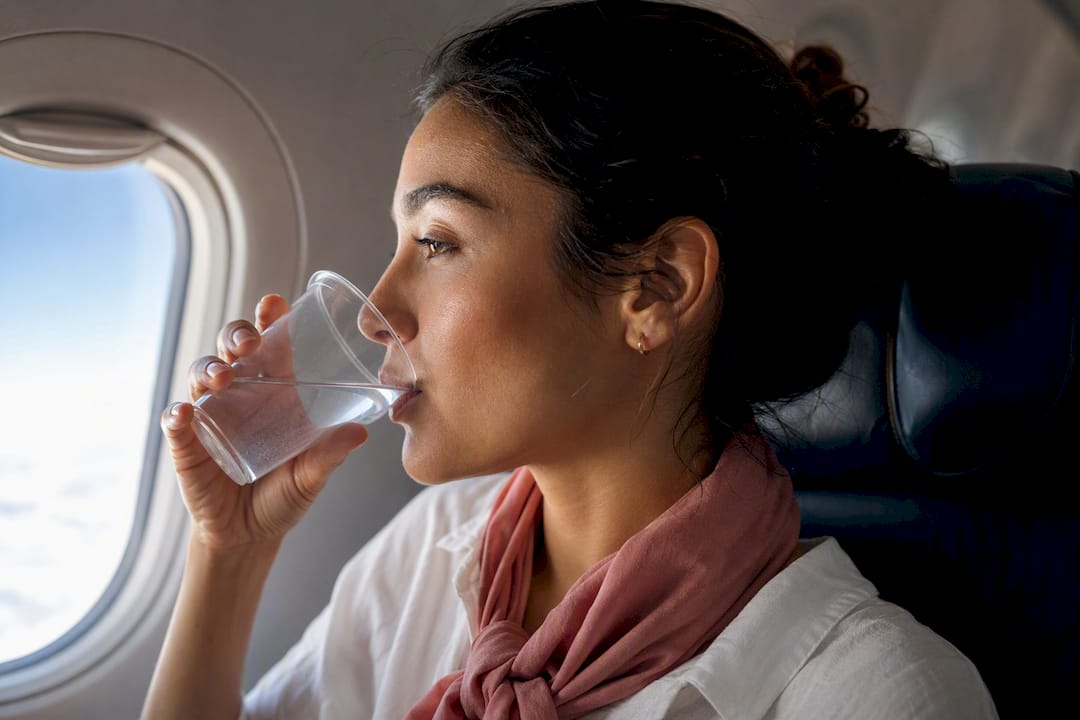
Post-flight recovery starts before you board. Skin that’s already well hydrated going into a dry cabin has more reserve to draw from, and it shows in how quickly it bounces back after landing. Drinking water in the hours before a flight, rather than relying on in-flight service alone, gives your body a head start against the dehydration that flying reliably causes.
During the flight itself, alcohol and caffeine work against you. Both are diuretics, and combined with cabin air that’s already stripping moisture from your skin, they accelerate the dehydration you’ll be fighting on arrival. Water is the better choice for the entire flight, not just the last hour before landing.
Topically, a hydrating facial mist applied every hour or two during a long flight keeps skin from hitting the extreme dryness that makes recovery slower. It’s a small habit, but it means you’re not starting your post-flight routine from a deficit. Passengers who hydrate consistently, both from drinking water and from topical mist, typically report less tightness and flaking on arrival than those who wait until landing to address it.
How to Protect Your Skin During a Dry Flight
You don’t have to wait until landing to start protecting your skin. A facial mist with glycerin or hyaluronic acid, applied over moisturizer every hour or two, keeps the skin surface from drying out completely during a long flight. Look for a fine, alcohol-free mist rather than a heavy spray, since alcohol-based formulas can dry skin further as they evaporate.
Personal humidifiers aren’t practical in a cabin, but a rich occlusive balm applied before boarding creates a similar effect by trapping whatever moisture is already in your skin. Apply it over your usual moisturizer right before takeoff, and skip powder makeup, which tends to settle into dry patches and make skin look worse by the time you land.
Avoid over-washing your face mid-flight. Cabin bathroom soap is often harsh, and stripping your skin at 35,000 feet only adds to the dehydration already happening. A hydrating wipe or micellar water is a gentler way to refresh without compounding the problem. Keep lip balm within reach too, since lips dehydrate faster than facial skin and chapping starts almost as soon as the cabin door closes.
Managing Redness, Irritation, and Breakouts After Flying
Flight-related skin issues usually fall into one of three patterns, and each responds to a different fix rather than a single catch-all product.
Redness and irritation typically come from a compromised barrier reacting to recycled cabin air and low humidity. Calm it with fragrance-free products containing centella asiatica, allantoin, or oat extract, and hold off on anything exfoliating until the redness settles, usually within a day or two.
Breakouts after flying are often less about oil and more about a stressed barrier and touching your face more than usual in transit. A non-comedogenic moisturizer and a targeted spot treatment work better than switching to a stripping cleanser, which can trigger a rebound in oil production.
Persistent tightness or flaking signals barrier depletion rather than a new problem. Layering a humectant under a ceramide-heavy moisturizer for a few days, as outlined in the 72-hour recovery plan, usually resolves it without needing a new product entirely.
Does Skin Type Change Your Post-Flight Routine?
Skin type shifts the details, not the framework. Cleanse, hydrate, seal still applies across the board.
Dry skin takes the hardest hit from cabin air and needs the richest moisturizer you’re willing to travel with, plus a hydrogel mask for extended contact time whenever there’s a layover or downtime to use it.
Oily and acne-prone skin still dehydrates on a flight, even though it may not feel that way. The mistake is skipping moisturizer to avoid feeling greasy, which only pushes skin to overproduce oil. A lightweight, non-comedogenic gel moisturizer with ceramides delivers hydration without the heavy finish.
Sensitive skin reacts fastest to cabin conditions and to any new product introduced mid-trip. Stick to products you’ve already patch-tested at home, keep the ingredient list short, and lean harder on soothing actives like niacinamide over anything with fragrance or essential oils.
A Note From the Brand on Recovering After a Flight
These masks are designed around a simple idea: skin recovers best with fewer, better steps, not more products stacked on top of each other. A hydrogel mask that stays on longer and seals in hydration does more for jet-lagged skin than five new serums bought at the airport. Save the new actives for when you’re home and settled.
Recover Faster With a Travel-Ready Hydrogel Mask
Overnight recovery gets harder when your skin is fighting cabin dryness on top of normal daily stress. A hydrogel mask solves the timing problem other formats can’t: it stays sealed against skin for hours, which matters far more after a flight than a five-minute sheet mask ever will.

Use the Vervex biodance mask right after your post-flight cleanse, once your humectant serum has absorbed. Leave it on for a 20 to 40 minute boost if you’re short on time, or overnight if you’ve landed and you’re heading to bed. The mask turns transparent as it’s absorbed, so you can actually see the hydration sinking in rather than guessing whether it’s working. Its individually sealed packaging travels clean in a carry-on, no jars or spills. If you fly often, the Biodance Bio-Collagen Real Deep Mask 4-pack keeps a recovery mask on hand for every trip without restocking between flights. Check the product page and add one to your next travel kit before your next departure.