
Hydrogel masks deliver intense hydration and a cooling, soothing effect from the first use, and that part is easy to confirm. The bigger payoff shows up with repeat applications: clinical measurement links three weekly uses over several weeks to measurable gains in hydration and firmness, with good tolerability even on sensitive skin. Expect an instant plumping effect right away, and cumulative improvement if you stick with it.
TL;DR:
- Repeated use of hydrogel masks over several weeks significantly improves skin hydration and firmness according to clinical measurements.
- Hydrogel masks maintain better contact and ingredient delivery due to their flexible gel matrix and occlusive sealing effect.
- They are safe for sensitive skin when patch tested and formulated with minimal preservatives, with no irritation reported in clinical trials.
- Overnight hydrogel masks provide sustained hydration and firming benefits, especially when used regularly over weeks.
- For best results, apply masks after cleansing, press gently to eliminate air pockets, and leave on for the recommended time or overnight for extended benefits.
Table of Contents
- What Is a Hydrogel Mask, Exactly?
- How Do Hydrogel Masks Work on Skin?
- What Are the Main Hydrogel Mask Benefits?
- How Should You Use a Hydrogel Mask?
- Are Hydrogel Masks Safe for Sensitive Skin?
- What Does the Clinical Evidence Actually Show?
- Why Vervex Builds Overnight Hydrogel Masks This Way
- Try the Biodance Bio-Collagen Real Deep Mask
- Sources
What Is a Hydrogel Mask, Exactly?
A hydrogel mask is a water-rich polymer sheet, not a piece of soaked fabric. Traditional sheet masks rely on a cotton or fiber base that just holds serum; hydrogel masks are built from a gel matrix that is itself mostly water, so the mask conforms to your face and holds contact far more evenly than fiber ever does.
That tighter fit matters. It’s the reason hydrogel masks feel cool and slightly springy on contact, closer to a spa compress than a damp cloth.
Common formats and ingredients include:
- Full-face sheets, targeted eye patches, and overnight variants meant to stay on for hours.
- Hyaluronic acid and glycerin for water retention.
- Peptides for firmness support.
- Botanical extracts for calming sensitized skin.
Because the polymer network itself carries the water, hydrogel masks don’t dry out and curl at the edges the way fiber sheets do after 15 minutes.
How Do Hydrogel Masks Work on Skin?
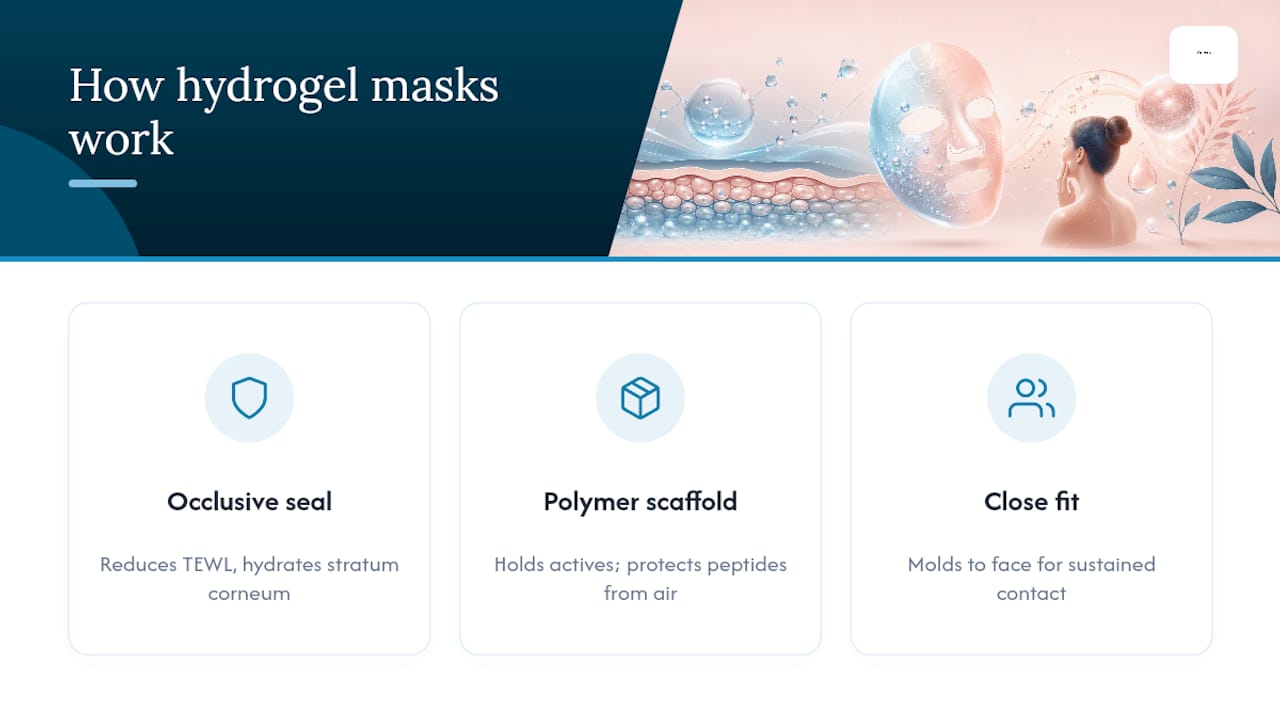
The mechanism comes down to occlusion. A hydrogel mask forms a physical seal over the skin, and that seal reduces transepidermal water loss, or TEWL, the process by which moisture normally evaporates off the skin’s surface. Less water leaving means more water available to hydrate the stratum corneum, the outermost layer of skin cells.
Hydrogel’s polymer structure does more than trap moisture, though. Research on topical hydrogel science describes it as a three-dimensional hydrophilic network, essentially a molecular scaffold that holds active ingredients suspended in place rather than letting them evaporate or degrade on contact with air. That protects delicate compounds like peptides, which break down quickly when exposed to light or oxygen, and it releases them gradually while the mask is on your face instead of dumping them all at once.
Physical fit plays a role too. Because the gel molds tightly to the contours of your face, cheeks, nose bridge, under-eye area, it maintains skin contact that a looser cotton sheet can’t match. More sustained contact means more consistent ingredient transfer, which is part of why hydrogel formats tend to outperform non-occlusive masks on hydration metrics in side-by-side testing.
What Are the Main Hydrogel Mask Benefits?
Each benefit has its own timeline, and knowing which is immediate versus which builds over weeks helps you set realistic expectations.
Deep hydration shows up fast. In one trial measuring skin moisture with a corneometer, an instrument that reads electrical conductivity to gauge water content, hydration jumped noticeably after a single application, and climbed even higher after repeated use over the same study. That’s the core distinction: a single mask gives you a real but temporary boost, while consistent use compounds the effect.
Soothing and cooling come largely from the water-heavy gel itself, which is why hydrogel is a popular pick for reactive skin or post-procedure recovery, after microneedling or light chemical peels, for instance, when skin needs calm more than active treatment.
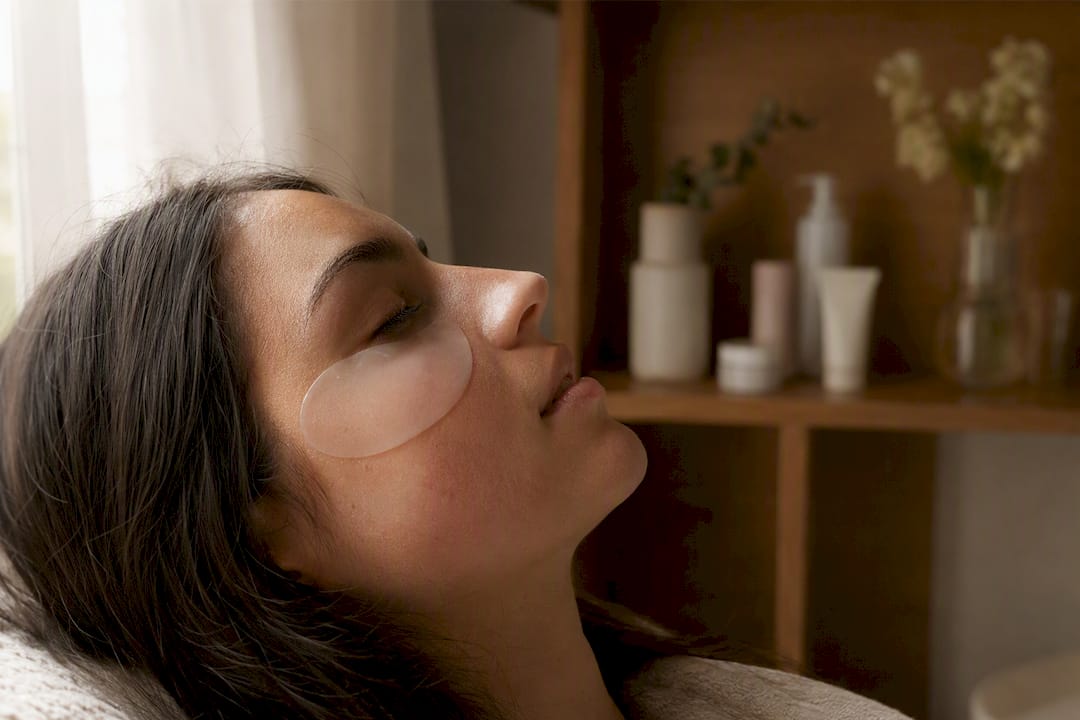
Plumping and firming improve with repetition. The same trial reported visibly reduced signs of aging after multiple applications, using standardized visual grading rather than a subjective before-and-after photo comparison.
Enhanced ingredient delivery happens because the gel matrix shields labile actives, ingredients that degrade easily, like certain peptides and vitamin C derivatives, and controls how fast they release into skin.
De-puffing is where cold and occlusion combine most visibly, especially with eye patches, where a chilled hydrogel format constricts surface blood vessels for a quick contouring effect.
How Should You Use a Hydrogel Mask?
Getting the benefits above depends on how you apply the mask, not just which one you buy.
- Cleanse your face first. Any leftover makeup or oil creates a barrier between the gel and your skin, and that barrier blocks hydration transfer.
- Apply the mask and press gently from the center outward to eliminate air pockets. Trapped air breaks contact and wastes the occlusive effect that drives hydration.
- Leave it on for the time your product specifies. Clinical protocols have tested 20 minutes at a time, three sessions per week, which is a reasonable baseline if your packaging doesn’t specify otherwise.
- For overnight formats built for extended wear, leave the mask on while you sleep so ingredient delivery continues over several hours instead of just 20 minutes.
- Remove the mask and press any remaining serum into your skin rather than wiping it off. Follow with a moisturizer if your skin feels like it needs an extra seal.
Storing your masks in the refrigerator does double duty: it keeps the gel fresh and adds that cooling, de-puffing effect at application. If you’re layering with other actives, apply thinner serums first and let them absorb before placing the mask, so you’re not diluting either product.
Are Hydrogel Masks Safe for Sensitive Skin?
Patch testing is the simplest safety check before committing to a new mask, especially one with actives you haven’t tried. Apply a small piece to your inner forearm, wait 24 hours, and check for redness, itching, or bumps before putting anything on your face.
The published evidence is reassuring here. A six-week clinical trial in adults with self-reported sensitive skin reported no irritation across the study period, even with regular use. Fragrance and certain preservative systems remain the most common triggers in skincare generally, which is why hypoallergenic, minimally preserved formulations tend to be the safer default for reactive skin. If you’ve recently had a procedure like microneedling or a peel, give your skin a few days to recover before introducing a new mask, and check with a dermatologist first if you have a known reactive skin condition.
What Does the Clinical Evidence Actually Show?
The strongest data point comes from a trial using 20-minute applications three times weekly for six weeks, which reported measurable gains in hydration and firmness without disrupting the skin barrier. Measurement tools matter here: a Corneometer tracks hydration through electrical conductivity, while a Chromameter reads skin tone and texture changes, and researchers supplement both with visual grading by trained evaluators.
| Measurement | What it tracks | Reported direction |
|---|---|---|
| Corneometer | Skin surface hydration | Increased after single use, larger increase after repeated use |
| Visual grading | Signs of aging (fine lines, texture) | Reduced after single use, greater reduction after repeated use |
| Tolerability tracking | Irritation, redness | No irritation reported over several weeks |
The caveats matter as much as the results. Sample sizes in these trials are small, and large randomized controlled trials remain scarce in this specific product category. Health explainers are right to note that single-session effects are often transient, lasting hours rather than days, while the firmness and texture gains require sustained, repeated use to hold.
Why Vervex Builds Overnight Hydrogel Masks This Way
We designed our masks around overnight wear because sustained contact, not a quick 15 minute sit, is what the evidence points to for lasting results. The mask turns transparent as it’s absorbed, so you can see the process working. Formulas stay hypoallergenic, and with reported hydration gains from over 100,000 customer reviews, we still recommend a patch test if your skin runs sensitive.
— Vervex
Try the Biodance Bio-Collagen Real Deep Mask
If you want the overnight hydration and firming benefits covered above in a single product, the Biodance Bio-Collagen Real Deep Mask is built for exactly that. It’s formulated for the “glass skin” look, smooth, dewy, visibly hydrated, and designed to wear overnight so the gel has hours rather than minutes to work.
![CTA Image]
The formulation is hypoallergenic and positioned for sensitive skin, and it comes in a pack of four for anyone who wants to build the repeated, consistent use that the clinical data ties to firmness gains rather than a one-off treatment. Pair mask nights with a compatible tool like a LED facial device if you already use light therapy in your routine. If you’d rather see the full formulation details first, check the biodance mask product page. Ready to try it yourself? Order the pack of four and start your first overnight session tonight.
Sources
- Clinical investigation of hydrogel mask use in sensitive skin (PubMed entry)
- Clinical trial reporting corneometer and visual grading improvements (MDPI Cosmetics)
- Polymer science and topical hydrogel review (PMC)
- Do face masks actually work? (Cleveland Clinic Health Essentials)