
The minimal, effective routine for busy moms is three steps, twice a day: cleanse, moisturize, and apply SPF in the morning, then cleanse and moisturize again at night. That’s it. A full face of skin care in under five minutes is realistic on most mornings, and a hands-off overnight mask like Vervex can cover the recovery work while you sleep.
TL;DR:
- Use a two-finger application method for sunscreen to ensure the correct amount and proper coverage for the face and neck.
- Incorporate multitasking products, such as a moisturizer with SPF or an antioxidant serum, to combine steps and save time.
- Adjust surface moisturizers and cleansers seasonally by choosing richer formulas in winter and water-based gels in summer.
- Limit nighttime treatments like overnight masks to one or two nights a week to prevent overloading the skin barrier.
- Keep core skincare products within reach in multiple locations to promote consistency and reduce skipped steps.
Table of Contents
- Quick Skincare for Busy Moms: The Core Daily Routine
- A 5-Minute Morning Skincare Routine You Can Actually Follow
- Multitasking Products That Cut Your Routine in Half
- Storage and Habit Hacks That Make Skin Care Stick
- Low-Effort Treatments for Nighttime Repair
- How the Vervex Overnight Hydrogel Mask Fits a Busy Routine
- Fixing Acne, Dryness, and Dullness Without Adding Steps
- Adjusting Your Quick Routine for the Seasons
- My Real-Talk Checklist for Busy Mornings and Nights
- An Overnight Option Worth Adding to Your Shelf
- Where This Guide’s Recommendations Come From
- Sources
Quick Skincare for Busy Moms: The Core Daily Routine
Dermatologists agree on three non-negotiable steps: cleanser, moisturizer, and sunscreen. Everything else, serums, exfoliants, treatment masks, is optional extra credit. The Cleveland Clinic frames the morning routine as gentle cleanser, optional antioxidant serum, and SPF 30+, with the evening routine focused on cleansing and repair. That’s the whole system.
Here’s how to make each step fast without cutting corners:
- Cleanse for 30 seconds. Massage cleanser in circular motions across your forehead, cheeks, nose, and jawline. That’s long enough to dissolve dirt, sweat, and makeup.
- Moisturize while skin is still damp. This helps lock in hydration instead of letting it evaporate.
- Apply sunscreen using the two-finger rule. Squeeze two full finger lengths of sunscreen for your face and neck.
Broad-spectrum SPF 30 blocks about 97% of UVB rays, which is why dermatologists treat it as mandatory, not optional, even on cloudy days.
Pro Tip: Reapply sunscreen every two hours if you’re outdoors for school pickup, the playground, or errands. A powder SPF stick makes this a five-second fix over makeup.
A 5-Minute Morning Skincare Routine You Can Actually Follow
Set a timer once and you’ll see how little time this takes. Here’s the minute-by-minute breakdown:
- Minute 1: Splash water and massage in a gentle cleanser for 30 seconds. Rinse and pat dry.
- Minute 2 to 3: Apply a multitasking serum, something with antioxidants or hyaluronic acid, while your face is still damp.
- Minute 3 to 4: Layer on a moisturizer. If it already contains SPF 30 or higher, you just cut a full step.
- Minute 4 to 5: If your moisturizer doesn’t have SPF, apply sunscreen separately using the two-finger rule.
On mornings that fall apart before they start, swap in a tinted moisturizer or BB cream with built in SPF. It covers hydration, sun protection, and light coverage in one swipe. On the truly no-time days, a gentle facial wipe followed by a dab of moisturizer beats skipping skin care entirely.
Pro Tip: Never skip the SPF step to save time, even when everything else gets rushed. Sun damage is the one skin concern that’s much easier to prevent than reverse.
Multitasking Products That Cut Your Routine in Half
The fastest way to shorten a routine isn’t skipping steps. It’s picking formulas that do double duty. Multitasking products like a moisturizer with SPF built in, or a serum that pairs hydration with antioxidants, let you combine two or three steps into one.
Look for these combinations when shopping:
- Hyaluronic acid + ceramides: hydrates and reinforces your skin barrier in a single product.
- Niacinamide + antioxidants: calms redness while offering some environmental protection.
- Moisturizer + broad-spectrum SPF 30 or higher: eliminates a whole separate step every morning.
On mineral versus chemical sunscreen, mineral formulas (zinc oxide, titanium dioxide) sit on top of skin and tend to suit sensitive or acne-prone skin better, though they can leave a slight cast. Chemical sunscreens absorb faster and layer more easily under makeup, but they take about 20 minutes to become effective after application.
One caution: don’t stack overlapping actives. Using a retinoid and a chemical exfoliant like glycolic or salicylic acid in the same routine increases irritation risk without adding real benefit. Dermatologists favor a simplified routine over a crowded one, since fewer active ingredients mean less chance of compromising your skin barrier.
Storage and Habit Hacks That Make Skin Care Stick
Consistency beats perfection, and consistency comes down to friction. Keeping products visible and within reach at the point of use is strongly linked to routine adherence among busy people.
A few adjustments that make a real difference:
- Keep a cleanser in the shower so washing your face happens automatically.
- Leave your moisturizer on the nightstand, not in a drawer or bathroom cabinet.
- Stock travel-size duplicates in your bag, car, or diaper bag for skipped mornings.
- Prep your nighttime products on the bathroom counter before bed, so there’s zero decision-making left when you’re exhausted.
- Keep a backup pack of facial wipes plus a travel moisturizer for the nights you’re too tired to do anything else.
Pro Tip: Duplicate your core three products in two or three locations. A second set at the sink and one in your bag removes the “I’ll do it later” excuse entirely.
Low-Effort Treatments for Nighttime Repair
Sheet masks and overnight hydrogel masks solve different problems. A sheet mask delivers a quick 10 to 15 minute hydration boost, useful before an event or on a night you have a few spare minutes. An overnight hydrogel mask works while you sleep, giving your skin hours of uninterrupted absorption instead of a rushed few minutes.
Passive, leave-on tools like overnight masks and reusable patches are built for exactly this kind of schedule. You apply once, then walk away. No timers, no second step, no attention required after that.
A few notes on safety before you add any overnight leave-on product:
- Patch test new formulas on your inner arm for 24 hours before applying to your face.
- Choose hypoallergenic, fragrance-free options if you have sensitive or reactive skin.
- Reserve overnight actives (retinoids, strong acids) for nights you’re not also using a leave-on mask, to avoid overloading your skin barrier.
Schedule these treatments for one or two nights a week rather than nightly. Your skin needs recovery time between more intensive sessions.
How the Vervex Overnight Hydrogel Mask Fits a Busy Routine
An overnight hydrogel mask solves a real problem for busy moms: you want visible results without adding a step to your morning. Vervex masks turn transparent as they absorb, which lets you actually see the nutrients sink in overnight instead of guessing whether a product is working.
Here’s what makes it fit into a low-effort routine:
- Apply after your evening cleanse, before or in place of your usual night moisturizer.
- Leave it on overnight and remove in the morning, no rinsing required mid-treatment.
- The formula is hypoallergenic and free from common irritants, which matters if pregnancy or postpartum skin has made you more reactive than usual.
- The product has received numerous positive reviews, with many users reporting noticeably better hydration.
Use it once or twice a week as a recovery boost layered into the storage habits above. Keep it on your nightstand next to your regular moisturizer so it’s part of the same two-minute bedtime routine, not a separate task you have to remember.
Fixing Acne, Dryness, and Dullness Without Adding Steps
You don’t need a five-step targeted regimen to manage a specific skin concern. You need one smart substitution inside the routine you’re already doing.
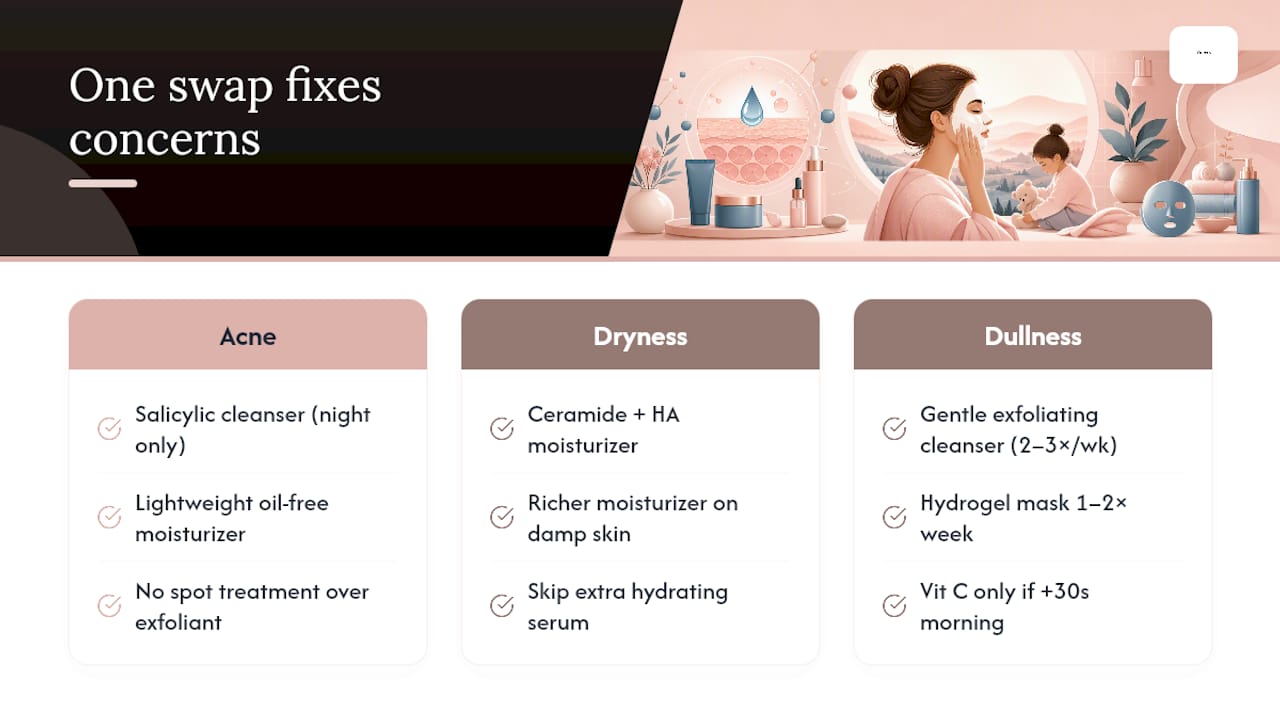
For acne-prone skin, swap your regular cleanser for one containing salicylic acid, and use it at night only to avoid over-drying. Skip heavy, pore-clogging moisturizers and choose a lightweight, oil-free formula labeled non-comedogenic. Resist the urge to add a spot treatment on top of an exfoliating cleanser. That combination is the fastest way to trigger irritation instead of clearing skin.
For dryness, look for a moisturizer built around ceramides and hyaluronic acid rather than reaching for an extra hydrating serum. A richer moisturizer applied to damp skin does most of the work a multi-step hydration routine would otherwise take.
For dullness, a gentle exfoliating cleanser two or three times a week, not daily, brightens skin without adding a new product to your daily lineup. Vitamin C serums help too, but only if you already have 30 extra seconds in your morning. If you don’t, an overnight hydrogel mask used once or twice weekly delivers a similar brightening boost with zero added morning time.
The pattern across all three concerns: treat the issue by upgrading one product you already use, not by bolting on a new one.
Adjusting Your Quick Routine for the Seasons
Your three-step routine doesn’t change. What goes inside each step should shift with the weather.
In colder months, swap a lightweight gel moisturizer for a heavier cream formula with ceramides to counter dry indoor heat and cold outdoor air. Skin that feels tight or flaky in winter usually needs richer occlusion, not more steps.
In summer, a gel-based or water-based moisturizer prevents the greasy, clogged feeling heat and humidity make worse. SPF matters just as much, arguably more, since longer days outdoors mean more cumulative UV exposure even on routine school-run errands.
Spring and fall are the seasons to reassess. If your skin feels congested after winter, a gentle exfoliating cleanser once or twice a week for a few weeks can reset things before summer humidity arrives. If allergy season leaves your skin more reactive, dial back active ingredients temporarily and lean on a simple, calming moisturizer instead.
The takeaway: keep the three-step frame constant year round, but treat your moisturizer and cleanser as the two products worth reevaluating every season.

My Real-Talk Checklist for Busy Mornings and Nights
Here’s what I actually rely on: cleanse, moisturize, SPF in the morning. Cleanse and moisturize at night. That’s five total steps across an entire day, and most mornings still ends up rushed.
Some nights I skip everything but a wipe and moisturizer, and that’s fine. A short daily ritual like this can genuinely lower stress, not just improve your skin. Consistency, not perfection, is what actually moves the needle over months.
— Vervex
An Overnight Option Worth Adding to Your Shelf
If your evenings leave you zero extra minutes, the Vervex hydrogel mask is built for exactly that gap. You apply it once before bed, and it does the hydration and repair work while you’re asleep, no extra morning step, no rinsing mid-treatment, nothing to remember except taking it off.

Use it once or twice a week in place of your regular night moisturizer, layering your usual products underneath if your skin runs on the drier side. For moms who want a steady supply without reordering constantly, the pack of four covers close to a month of weekly treatments in one order. If sensitive skin runs in the family, from your own reactive patches to a little one’s eczema, it’s worth reading up on gentle, barrier-friendly skin care approaches as a companion resource. Start with a single mask and see how your skin responds before committing to a full pack.
Where This Guide’s Recommendations Come From
The core routine steps and SPF guidance draw from the American Academy of Dermatology, the authority on sun protection standards. Cleansing technique comes from Healthline’s breakdown of proper contact time. Morning and evening step sequencing follows the Cleveland Clinic’s simplified routine guidance.