
The recommended frequency is 4 to 5 nights a week for dry skin, 2 to 3 nights a week for normal or combination skin, and just 1 to 2 nights a week for oily, acne-prone, or sensitive skin. The exact number shifts based on the mask’s formula, any active ingredients underneath it, and how your skin actually responds the next morning.
TL;DR:
- Dry skin can safely use sleeping masks up to five nights a week, especially in winter or low-humidity conditions.
- Oily or acne-prone skin should limit mask use to once or twice weekly to prevent pore clogging and over-nourishing.
- Strong actives like retinoids and acids should not be layered under masks on the same night, and patch testing is recommended before full use.
- Seasonal changes require adjusting frequency, with more frequent use in dry winter weather and reduced use during humid summers.
- Gentle, hypoallergenic masks with visible absorption help monitor effectiveness and prevent irritation, especially for sensitive skin types.
Table of Contents
- How Often to Use a Sleeping Mask for Your Skin Type
- How to Apply a Sleeping Mask Safely and Effectively
- Active Ingredients That Change the Frequency Math
- Seasonal Adjustments and Signs Your Barrier Needs a Break
- The Vervex Take on Frequency and Formulation
- Choosing the Right Vervex Mask for Your Routine
- Sources
How Often to Use a Sleeping Mask for Your Skin Type
Frequency isn’t a single number. It’s a range that depends on what your skin barrier can handle and what the formula is built to do.
Dry or dehydrated skin tolerates sleeping masks the most. You can use one 4 to 5 nights a week, and some people with genuinely parched skin go nightly during winter, when indoor heating strips moisture fast. K-beauty guides commonly support this range, recommending 4 to 5 uses weekly for dry skin and daily use in low-humidity months.
Normal or combination skin does best with an alternating rhythm rather than a nightly habit. Two to three nights a week is the standard advice across most skincare brands, giving your skin recovery nights in between.
Oily or acne-prone skin needs a lighter touch. Limit use to once or twice-weekly and choose a gel-based or oil-free formula, since heavier occlusive textures can trap oil against clogged pores overnight. Dermatology-informed guidance from Vinmec points to 1 to 2 times per week as the ceiling for this skin type to avoid over-nourishing already-oily areas.
Sensitive or compromised-barrier skin should treat frequency as a moving target. Start with once a week, watch how your skin reacts, and only increase if there’s zero stinging or redness. If your barrier is visibly compromised (flaking, tight, or reactive to nearly everything), a consult with a dermatologist beats guessing.
Use these morning cues to adjust:
- Skin feels comfortably plump, not tacky or greasy: your frequency is working.
- New breakouts appear within a day or two: cut back immediately.
- Redness lingers past mid-morning: skip the next scheduled night and reassess the formula.
How to Apply a Sleeping Mask Safely and Effectively
A sleeping mask is the last step in your night routine, applied after serums and moisturizer have had time to settle in.
- Cleanse and complete your normal serum and moisturizer steps first.
- Scoop a small, dime-to-quarter sized amount, scaled up slightly for a thicker gel texture.
- Apply an even layer across your face, avoiding the eye area unless the product is labeled safe for it.
- Wait 10 to 30 minutes before getting into bed. Healthline notes this pause reduces how much product transfers to your pillowcase once the formula has had time to set.
- In the morning, rinse with lukewarm water or a gentle cleanser, depending on how much residue remains.
Pro Tip: Keep a dedicated spatula next to your mask jar instead of dipping fingers in. It prevents bacteria transfer into the product and keeps the texture consistent night after night.
If your serum underneath contains silicones or heavy polymers, give it 3 to 5 minutes to absorb before layering the mask on top. Skipping that gap is the most common cause of pilling, where product balls up instead of spreading smoothly.
Active Ingredients That Change the Frequency Math
Sleeping masks work by sealing moisture and actives against your skin overnight, and that occlusion cuts both ways. It boosts hydration, but it also increases how deeply anything else on your face penetrates, including ingredients you’d normally want to apply with restraint.
That matters most on nights you’re already using strong actives. Retinoids, high-strength AHAs, and benzoyl peroxide all become more intense under an occlusive layer, since the mask traps them against skin instead of letting them evaporate or buffer naturally overnight.
Practical rules for that overlap:
- Never layer a sleeping mask directly over a fresh retinoid or high-percentage acid application on the same night.
- On active-treatment nights, skip the mask entirely or swap in a purely hydrating formula with no additional actives.
- Patch test any new sleeping mask on your inner arm or jawline for two nights before working it into your full routine.
- Increase frequency gradually. Start at once a week for two weeks before moving up to your target range.
Occlusion increasing active penetration is a well-documented concern among K-beauty formulation guides, and it’s the main reason dermatology sources caution against treating every night as mask night. If you’re unsure whether your current retinol or acid routine leaves room for a sleeping mask, a lighter moisturizer or a rinse-off mask on those specific nights is the safer substitute.
Seasonal Adjustments and Signs Your Barrier Needs a Break
Climate changes what your skin can tolerate, so your mask schedule should move with the seasons instead of staying fixed year-round.
In dry winter months, dry-skin users can push toward the top of their range, sometimes nightly, since indoor heat and cold outdoor air both pull moisture from skin faster. In humid summer months, oily and combination skin types usually need to scale back, since ambient moisture already does part of the mask’s job.
Watch for these barrier-stress signals regardless of season:
- Flaking that gets worse instead of better after a few uses.
- Persistent stinging or redness that shows up within minutes of application.
- New closed comedones or small bumps appearing where they hadn’t before.
If you spot any of these, pause the mask for a week and switch to a bare-bones routine: a gentle, fragrance-free cleanser and a ceramide-rich moisturizer to let the barrier settle. Also worth knowing: pilling and pillowcase staining tend to spike in humid weather when formulas don’t fully absorb, so a silk or easily washable pillowcase is a small, practical fix worth making before you troubleshoot the product itself.
The Vervex Take on Frequency and Formulation
We built Vervex around a simple idea: you shouldn’t have to guess whether a mask is actually working. Our hydrogel formula turns transparent as it absorbs, so you can see the nutrient penetration happening instead of just hoping the ingredients are doing something.
That visibility also makes frequency decisions easier for sensitive and dry skin. Our formulas are hypoallergenic and built to be gentle enough for repeated use within the ranges outlined above, and it’s part of why we’ve built a base of more than 100,000 positive reviews, with most reporting noticeably better hydration. Skin feedback still matters more than any fixed schedule.
— Vervex
Choosing the Right Vervex Mask for Your Routine
If your skin runs dry or dehydrated, look toward a Vervex hydrogel variant built for deep hydration and elasticity. Something like the Biodance Bio-Collagen Real Deep Mask fits comfortably into a 4 to 5 night weekly rhythm because the hydrogel texture absorbs fully instead of sitting heavy on skin.
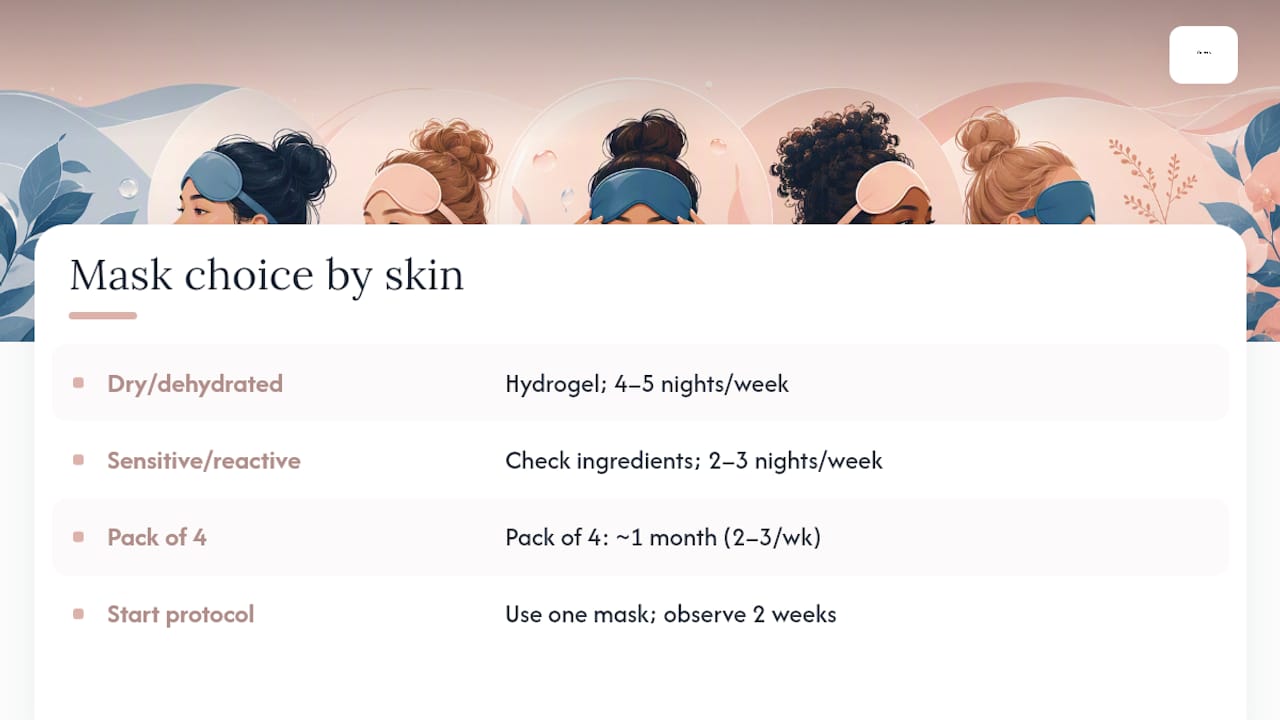
For sensitive or reactive skin, check the ingredient list on each product page before adding a new mask into rotation. Vervex formulas skip common irritants, which is why they work for people who’ve had reactions to heavier overnight creams in the past. If you’re stocking up for a consistent 2 to 3 night weekly routine, the pack of 4 Biodance bundle covers close to a month without reordering. Start with one mask, watch how your skin responds over two weeks, and adjust frequency from there using the ranges above as your baseline.
Sources
- Overnight Masks: The Sleepy Secret to Glowing Skin — Healthline
- Korean Sleeping Mask Guide | K-Beauty Reviews
- Is It Safe to Apply a Sleeping Mask Every Night? — Vinmec
These sources are useful for general guidance, but persistent irritation or breakouts deserve a conversation with a dermatologist rather than more research.